Romare Bearden’s Black Odyssey’s Power: Asserting ‘BlackCool’ Aesthetics and Uses of the Erotic (2014)
©2026 Barbara Columbus
Michael C. Carlos Museum in Atlanta, Georgia housed the Smithsonian Institute’s traveling exhibition, Romare Bearden: A Black Odyssey, curated by Robert G. O'Malley during the winter season of 2014. A Black Odyssey is a visual art presentation based on Homer’s classic Greek epic, The Odyssey. It is rearticulated through the Black cultural imagination. The curatorial direction centered on this 1977 collection in supplement to Romare Bearden’s other series of art work. Southern Connections: Bearden In Atlanta, observed the great affinity and kinship that Bearden had with Atlanta, Georgia and overall with Black southern culture. The Iliad Series was a black and white sketch outline presentation of the inglorious, aggression and cruelty of the last throes of war. Representing only desolate, ghostly silhouettes, Bearden articulated how hostility and violence did not inspire, sustain nor color his own life-force. Yet, A Black Odyssey elicited a romanticized sense of security within me given the artist’s colorful conceptualization of liberation, passion, self-determination, refuge, sensuality, self-subjectivity, vulnerability, and self-assertiveness. The pisces moon element within me willfully negotiated a sense of escapism within this Bearden’s artistic set. I experienced a magical but short-lived resolve of what Dr. Maya Angelou revealed from her political expatriation to Ghana in 1962 when she said, “the ache for home lives in all of us; the safe place where we can go as we are and not be questioned.” (2010, 196) And then upon my exit of the Carlos museum, the vicarious dream had fleeted. A Black contemporary reality that had yet to meet its ‘Odyssey’ in full fruition. In deeper contemplation, the artwork was Bearden’s artistic visualization of how the manifestation of self, psychology and spirituality would affirm the reality of A Black Odyssey. The exhibit’s version elicits a reassertion of power, not speaking particularly of the usual icons of violence and dominance, but on the audacity of asserting a ‘Blackcool’ aesthetic and an unapologetic, varied use of erotic energy. I will discuss in further how Romare Bearden’s production of a ‘Blackcool’ aesthetic and an erotic value was a reassertion of power in Black identity and subjectivity.

Romare Bearden
At first entrance of the dimly lit exhibit room, I was invited to explore the so-called mythical world of A Black Odyssey with the accompaniment of a wistful, melancholic, long-noted, jazz horn traveling as the background music of a video feature of the artist. Bearden was stirred by jazz and blues of his time. The authenticity, improvisation and coolness of the two musical genres enriched his creativity, and led to the production of his own visual artwork. His art ideas, being just as extemporizing as well, complementing to jazz and blues, Bearden’s work seemed to typically flirt in between both modernism and postmodernism styles while depicting Black characters, culture and life. He also seemed to practice in cubism in style in combination with collage methods using pre-constructed material sources. At the entrance of the exhibition, a wall text captured Bearden’s ideas on how universal and timely the classic mythos still is: “...what struck me about the Odyssey is that all of us, from the time we begin to think are on an odyssey....And I think this is what makes the story so lasting, so classic, and applicable to everyone.” A Black Odyssey is indeed a colorful, visual poem; however, that depends on the viewers’ contextual awareness of the history of socialized, Black bodies in the West, colonization, race, racism, sexism and spirituality in order to reflect on the strength and value of the artist’s work.
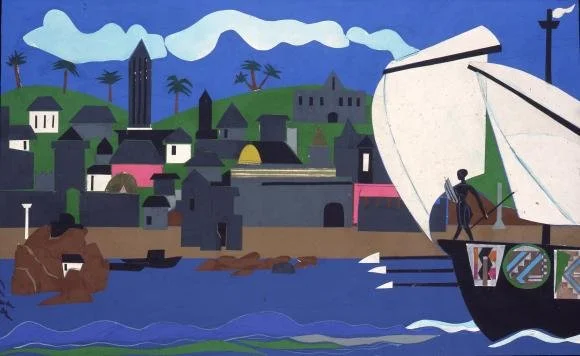
Trojan War, Home to Ithaca. Romare Bearden, 1977
Romare Bearden’s collage paintings combined aesthetics of coolness and aesthetic representations of blackness together as an assertion of power in Black identity. Although, there were wars and litanies of death throughout the classic, Bearden emphasized many of his collage paintings with blue skies, fluffy clouds, high and elevated mounds, tropical vegetation, wild and exotic animals, and the deep, blue sea. In spite of the deaths and victories incurred from the Trojan War, Home to Ithaca – the first image of the exhibit – provides a calm, cool and undisturbed balance to the presentation. The natural scenery is in accompaniment of various shapes of building structures. Odysseus’ ship is moving progressively forward and homeward bound, cool and unaffected by earlier episodes of war and struggle. At the head of the ship is a relaxed, feminine, black silhouette figure casually guiding the sail with an armored shield in one hand and a sword in the her other hand. The representation of the black feminine is very poised in presentation and strong and curvy in form. There is assertiveness in her presentation; a display of agency in her own physical, emotional and psychic expressions and well-being, as also seen in other female human characters within A Black Odyssey collection. The significance of these symbols is that Bearden’s human figures securely enjoy their own imagination of blackness and its experience in a way that differs with Black contemporary realities in the Western world. As a Black man of a lighter phenotype, the artist used this artwork to challenge Western constructions of Black bodies of expression and the negative consequential racial internalization of deep, rich melanin. But also, he used the colors and forms of other features in the collage as an accessory and reinforcement to the woman’s character and integrity. Assuming a position at the head of the ship independently - armor and weapon in both hands - gives insight to her confidence and cool resilience. The intensity of her black-silhouetted skin is an ingrained reflection of the black and gray, sturdy, building structures. However, her hue is also a warm offset to the green vegetation, blue sky and soft, white clouds. And yet, the calm, cool, and natural scenery complemented the integrity of her character and physical blackness. Bearden tied in all of these features, colors, style and form on the collage that translated to a black, cool, assertive and soulful aesthetic that Rebecca Walker likes to conceptualize as the innate “blackcool” of Black bodies of expression. Walker professed this concept as a way to recognize and celebrate a distinctive aesthetic that “is made up of elements that can be traced back to a place, a people, and a culture...” When explaining this concept, she characterized a particular artist who, “through audacious aesthetic choices, asserted a profound authenticity and thus resistance to all that would rob her of her subjectivity”. (2012, xi –xv) This is the power that Romare Bearden illuminated in A Black Odyssey.
Indeed, Mr. Bearden created various sources of representations and evocations of power. One other concept that really amazed me was that he sacredly channeled into what Audre Lorde specified as the “Uses of the Erotic” - “… a resource within each of us that lies in a deeply female and spiritual plane, firmly rooted in the power of our unexpressed or unrecognized feeling”. In traditional Western history, the “erotic” has been rendered as a sign of “female inferiority” or weakness. Erotic energy must otherwise be internally repressed in order to channel power that is traditionally presented in the context of maleness or virility. The erotic is a creative energy that lies in an awareness of self and emotional fulfillment; it should not be confused with the pornographic. (1984, 53-59) Bearden sets free the patriarchal suppression of the “erotic”. He used icons, form and other aesthetics that represent this energy to evoke feelings of power and self-determination.
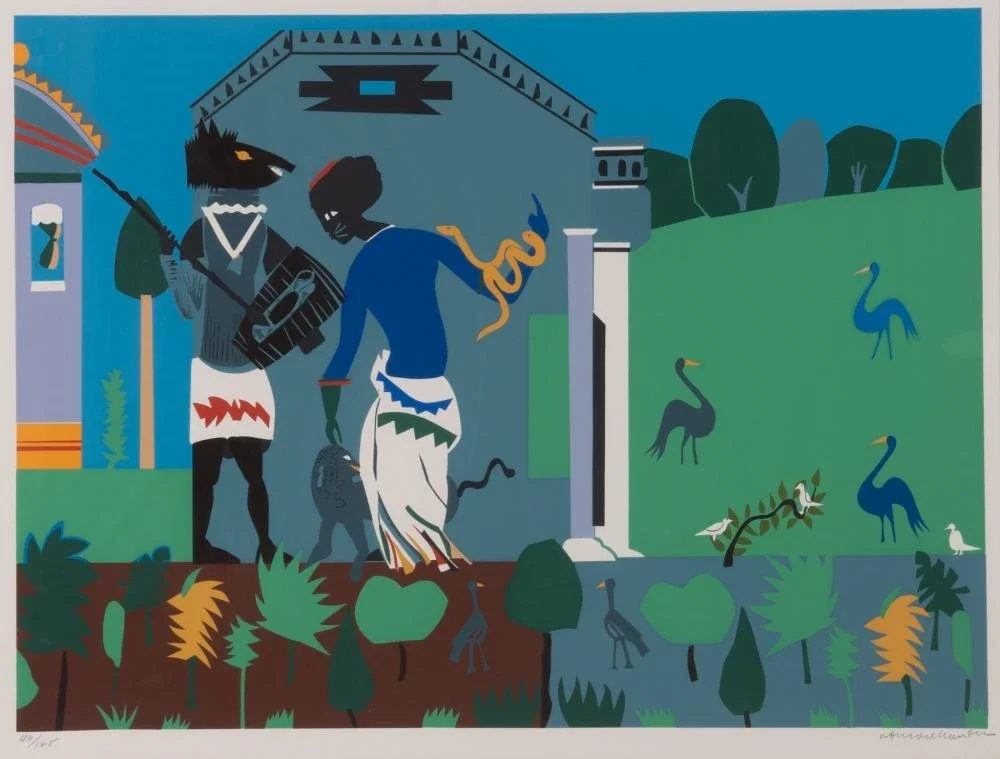
Circe Turns a Companion of Odysseus into a Swine. Romare Bearden, 1977
Circe Turns a Companion of Odysseus into a Swine, is a depiction of a witch – Circe – in the company of Odysseus’ crew member. He has been transformed into a pig, compliments of the work of Circe but he appears to be grinning at her - signifying his amusement. Unlike most other feminine bodies in Bearden’s exhibit, Circe is fully clothed. She’s wearing a long, free-flowing, feminine, white skirt with colorful, loose fringes at the bottom. Bearden accessorized her in such a way to display her complexity, as well as, to contradict the one-dimensional characterizations or images typically applied to Black women, witches or even African witchcraft. The ideology places a referendum on West African tradition. There are triangles observed throughout this particular art image. Downward-faced triangles – adorned on Circe’s skirt – are occult signifiers of femininity and water. The companion-turned-swine also has a downward-shaped triangle braced across his neck and chest. Upward-faced triangles are located on the house trim moldings which are occult signifiers of fire and masculinity. Bearden projected masculine energy in the structures. (Breyer, 2014) Circe is cohabited with a diversity of life-force and energy – non-human animals and plants. There are curvilinear forms composed within the images of many of the animals. The most significant is the serpent intimately wrapped around Circe’s arm. The closeness, bright yellow vigor, and curvature in form are expressing a feminine energy. The imagined perilous intimacy with a snake evokes emotions of fearlessness, sensuality and power. But yet, these were never considered redeeming qualities for the Black feminine, thus such energies were pressed to be silenced. Bearden attempts to override that criticism, censure and fear. He projects for the use of the erotic. He doesn’t portray her as devious or malicious, but as overly complex for understanding. With her fruitful association with various animals and a cultivation of green life, she is also projecting certain openness and sensitivity.
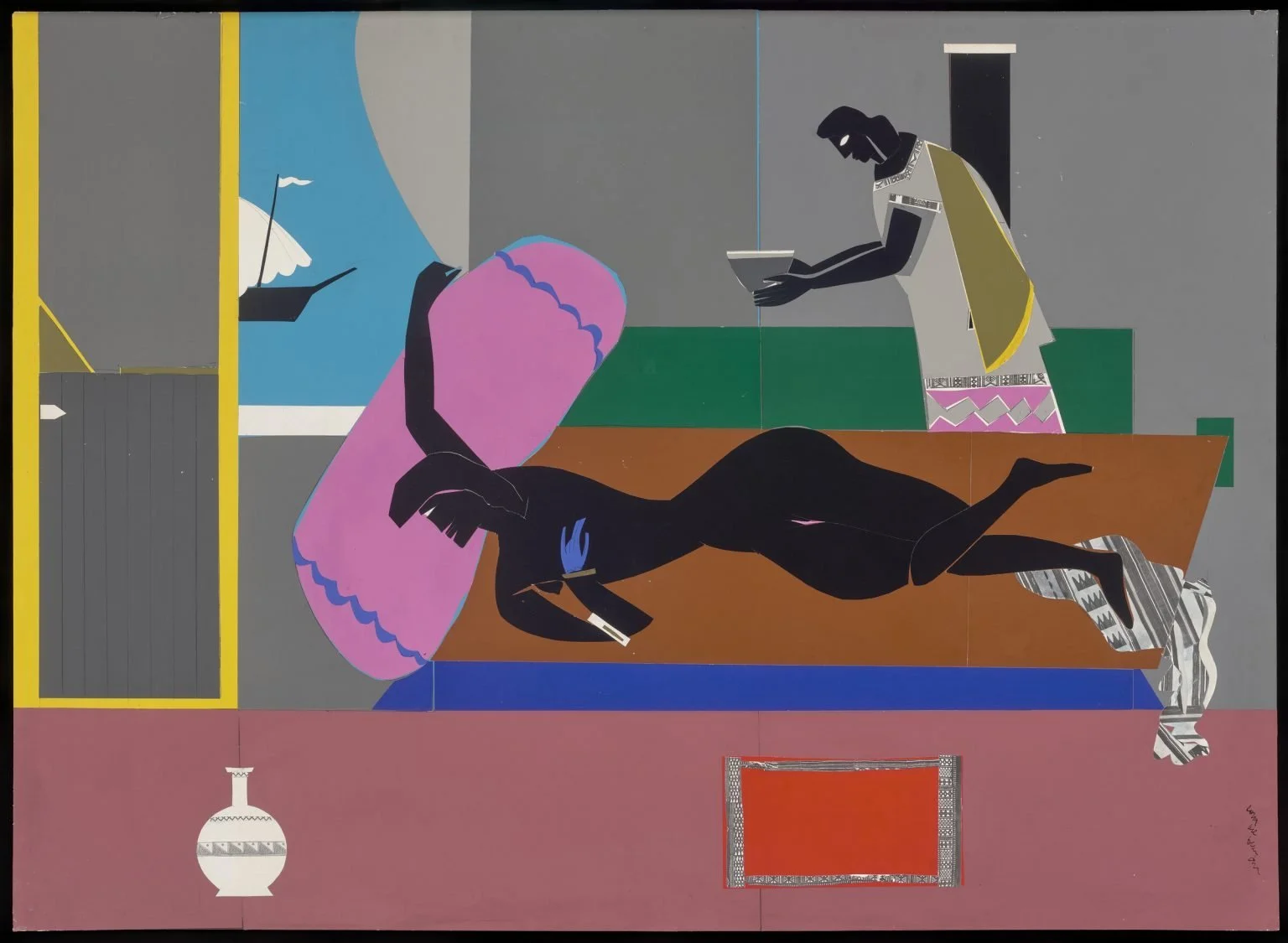
Odysseus Leaves Circe. Romare Bearden, 1977
Romare Bearden goes deeper into the complexity of Circe in his collage Odysseus Leaves Circe, a solemn image of Odysseus within his interior space; being nurtured by Circe. His room shows different forms and lines than from the exterior space in Circe Turns a Companion of Odysseus into a Swine. There are simple, flat, parallel and perpendicular lines that contrast with his black, stalwart, curvature lines. This flat rectilinear image elicits a feeling of vulnerability, but not weakness. There are only a few small details of curvature in the collage that complement his figure - a vase. He is lying in his bed nude. A puddle of water at the foot of the bed may be signifying a space of sunken feelings and healing. The open window shows Odysseus’ ship at sea. Seeking her deepest emotions as an occult, Circe is channeling the erotic as a “source of power and information”. (Lorde 1984, 54)
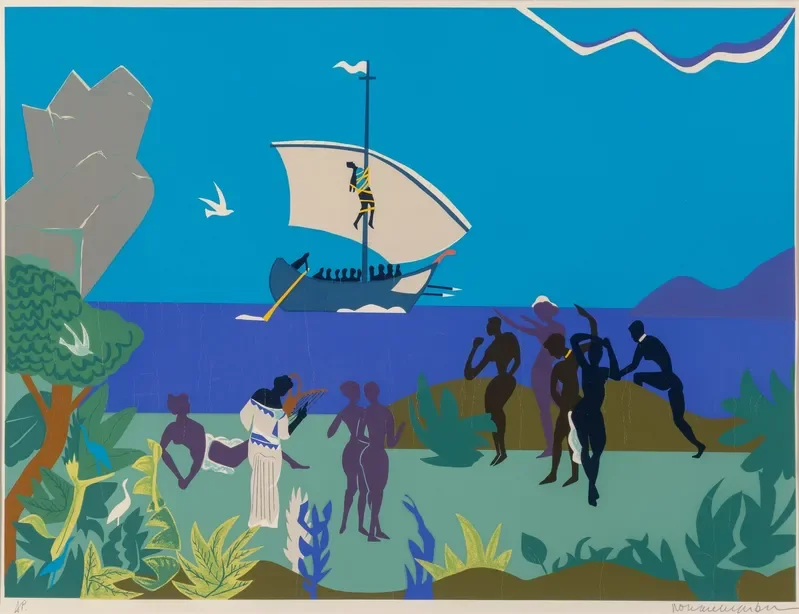
The Sirens’ Song. Romare Bearden, 1977
The Sirens’ Song collage is almost whimsical. The collective energy conjured from the visual of mostly nude Black women on the island almost makes oblivious the warring image of an antagonist tied in bondage and staked on top of Odysseus’ flag pole at sea range. The blue horizon and sea creates a cool, blue aesthetic. The abundance of tropical greenery is life-sustaining and signifies a holistic fulfillment for the women. However, there doesn’t seem to be any human male life existing on the island, which makes this image more dynamic with temptations. There’s a performance of a musical instrument and collective flirtatious gazing towards Odysseus’ ship. The green is an appealing earthly contrast against the rich melanin of the women’s bodies. The natural curvature in the blue hills and green mounds were accessories and complements to the natural, feminine curves of the women’s robust bodies. The natural pose of the women’s strong and resilient bodies curves and bows to one side into a sensual posture. There is an energy that is projected from the contrasts, complements and forms within the imagery that Audre Lorde suggests collects from a deep sense of self and self-determination. (1984, 54-59) This spiritual force is projected within the image.
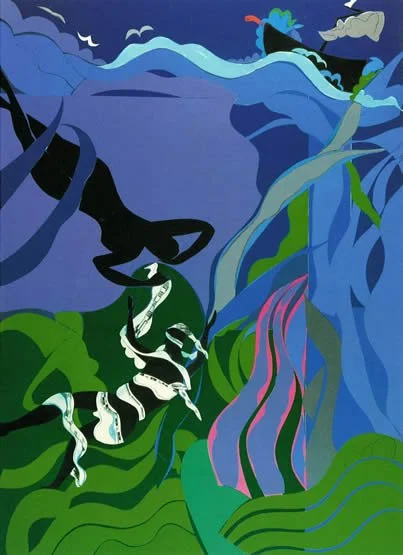
The mythical sea nymph – Ino – rescuer of Odysseus gives into the longing for liberation and safekeeping. Bearden’s colors, forms and lines create an island beneath the sea – a place of refuge – in The Sea Nymph. Odysseus being enwrapped in the curvilinear of the white ribbon and layers of sea greenery signifies an organic safekeeping. The curve forms in the ripples of the sea and in Ino’s body channels a feeling of the erotic, a realm of non-inferiority, sensuality and closeness. It is from this trust that Odysseus made it home safely.
After my completion of Romare Bearden: A Black Odyssey exhibit, I was resolved to the idea that Romare Bearden was moved by the power of ‘blackcool’ aesthetics and the power in the various forms and uses of the erotic. Through these power concepts, he found a way to illustrate themes of liberation, passion, self-determination, refuge, sensuality, self-subjectivity, vulnerability, and self-assertiveness. The Michael C. Carlos Museum centered on Romare Bearden: A Black Odyssey because the above-mentioned illustrations of power are most impressionable in inspiring the imaginations of the public. Southern Connections: Bearden in Atlanta is a celebration of the Black South, encompassed of artist, himself. . Iliad Series is a renouncement of antipathy and mere survival in hope of an exchange of passion, destiny and freedom. Romare Bearden: A Black Odyssey is a celebration and visualization of the fulfillment of Black people through the reimagining of a classic Greek mythology, jazz and blues music and the Black aesthetic.
Romare Bearden: A Black Odyssey via sitesExhibitions
Trains, Snakes and Guitars: The Collages of Romare Bearden via sitesExhibition
Bibliography
Angelou, Maya. All God's Children Need Traveling Shoes, Random House LLC, 2010.
Breyer, Catherine. "Elemental Symbols", Alternative Religions, accessed 03/16/2014.
Gates Jr, Henry Louis and Rebecca Walker. Black Cool: One Thousand Streams of Blackness, Soft Skull Press, 2012.
Kramer, Hilton. "Romare Bearden Tied His Work to Race, but was a Cubist." The New York Observer, 2003.
Lorde, Audre. "The Uses of the Erotic as Power." Sister Outsider: Essays and Speeches, Crossing Press, 1984.
Resnick, Lisa. "Hear with Your Eyes: Jazz and Art: How to Hear Bessie Smith "Sing" Bearden's Art." The Kennedy Center: Arts Edge (2014).
©2026 Barbara Columbus