Sacred Landscapes in Prehistoric North America: Deconstructing Iconography in Rock Art (2014)
©2026 Barbara Columbus
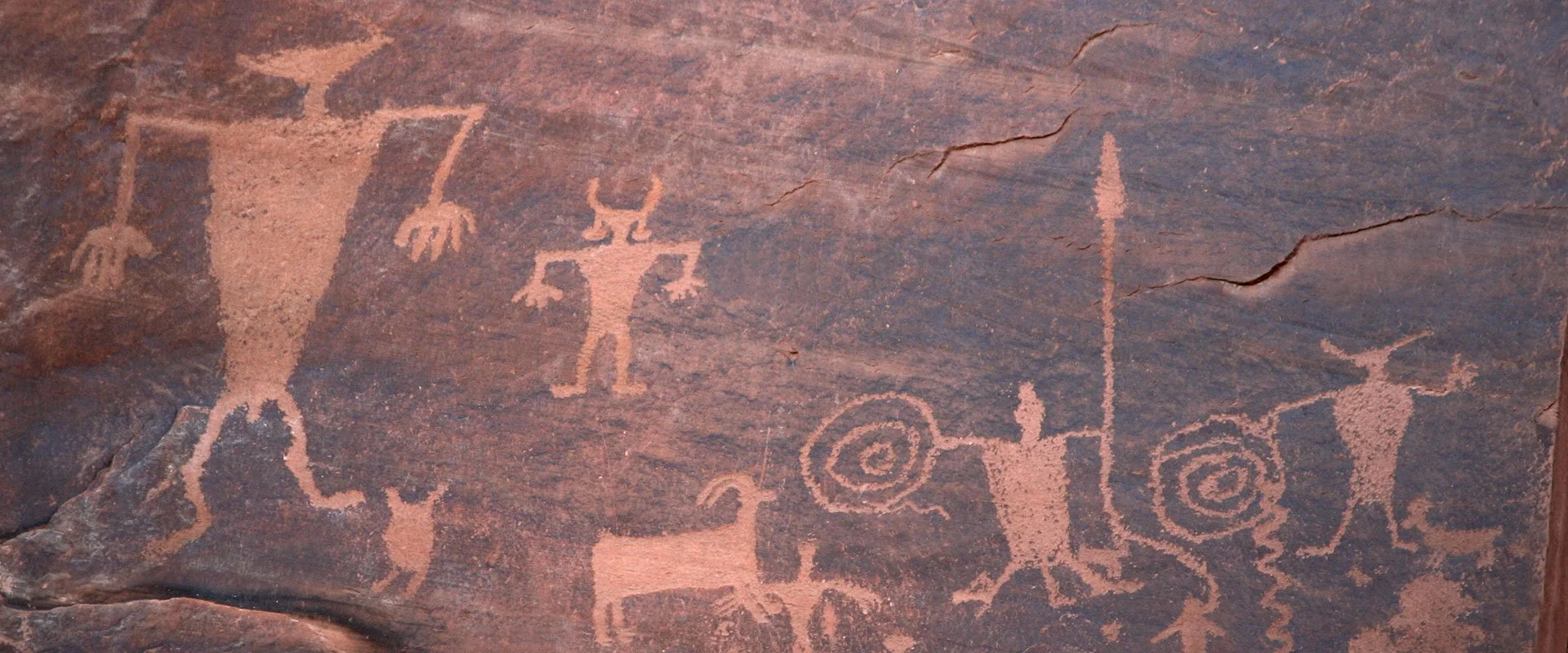
In this report, I will discuss various sites, styles, representations and technological methods of prehistoric rock art research spaced within the United States region. But most importantly, I will use these concepts to understand how such landscapes recognized with particular rock constructions and artistic aesthetics were highly valued as the most sacred and, perhaps, observed through ceremony. Many rock art depictions illuminate how inhabitants in the area subsisted and how they reacted to change within their environment. This discussion is sectioned into four different types of rock art: petroglyphs, pictographs, cave rock art and dendroglyphs. The dynamics of rock art in prehistoric North America is that the depictions provide narratives about particular subcultures that diverge from the classic understandings and partitions of the respective nine culture areas.
The most common form of rock art is the deep etched and carved surface of a platform. Petroglyphs are commonly located in the western region of the US where the climate is drier and more preserving of artifacts, ecofacts and features. In this region, particularly in the California and Great Basin region, the study of rock art artifacts reveals how the intersections between the sacred and climatic seasons manages the inhabitants’ cultural subsistence methods. However, it also reveals how archaeological interpretations of complicated and evolved religious cult ceremony are easily obfuscated. There had been various reports and assertions that there were connections between sacred magic and hunting – or sorcery - based on the depictions of the petroglyph rock art in the Coso Range sub-culture area, Eastern California. Keyser and Whitley (2006) report that assertions of hunting magic are unfounded, albeit it is true that the petroglyph rock art in that area originated out of the development of ritualistic observance. Garfinkel (2006:203-209), however, offers that in the context of Coso Range rock art, “hunting magic” is misunderstood and overly sensationalized, while the ritualistic symbolism of the “Coso Sheep Cult” petroglyph representations are minimalized. While the rock art expressions are most religiously observed during “ceremonies of Fall communal hunting of bighorn and a spring revival gathering”, “the rituals functioned to ensure ample game, bountiful plant resources, and perpetuation of the cosmic order of the universe”. Therefore, rituals were observed for spiritual manifestations of seasonal harvesting; not to embody sorcery for hunting.
The drier regions of the United States also preserved evidence of cultural or sacred paint depictions on rock surfaces using earth or animal-based resources – pictographs. Specifically, a significant deal of concentration in pictograph rock art, culture and technology has been placed in the Lower Pecos River Region in Val Verde County, Texas; near the River Grande tributary. Through the study of iconography, painting styles and technology resources, the inhabitants’ cultural evolution of pictographs is evidenced from mass landscape ceremonial use to small, rare individualistic use due to the climatic change in the region (Grieder, 1966).
The Lower Pecos River area of Texas regionally rests within the Southwest Culture Area; albeit it is a very diverse cultural region. Subcultures, sub-regions and time were distinguished. Neusius and Gross (2014:264) defined the Eastern Texas region as a culture, generically and prehistorically, that is evidenced of the practice of stone architecture, adobe masonry and pottery and it also practiced agriculture prior to adjacent areas. Grieder (1966) analyzed the Lower Pecos River region and attempted to re-conceptualize on the term “Desert Culture”, a concept that archaeologist Jesse Jennings had abandoned in 1973 due to the revelation that the actual diverse, cultural and geographical physiognomies within the Southwest and Great Basin was not similar characteristics, thus the cultures were not generically the equivalent (Neusius and Gross, 2014:235-236). (Grieder 1966) explains that the Archaic age in the Lower Pecos River area was a period of foraging, fishing and ceremonial practice that eventually shifted to deer hunting and less ritual observance due to the climatic changes affecting the subsistence and culture. Grieder used the study of pictographs and dating methods to make this observation. But also, it appeared that analyzing such data relative to other sub-regions and cultures was challenging. Speaking distinctively of the Pecos people’s art form and style in the Archaic period, Grieder (1966:720) says “the production of art on the scale of Pecos Style is unknown in other branches of the Desert Culture, so that direct comparisons cannot be drawn on the same time and developmental level.”
The Pecos people had a very ceremonial or ritualistic life style that were expressed and connected to the riverine and land. Grieder (1966) suggests that the act of painting pictographs were a performance of ceremonial ritualism. When an older pictograph was coated over with a new painting expression, it increased its “spiritual potency”. He suggests that the organic association between pictographs and rituals began in rock shelters. However, he speculates that there is a sparse pictograph record that depicts the performance of ceremonialism within rock shelters because everyone was of participation. Grieder’s comment:
“That the ceremonies were secret seems doubtful, however, if we imagine the paintings being done while the shelters were in-habited, as seems most likely. It would appear that the whole community participated in ceremonial life since the painted record of the ceremony remained to be seen.”
Evidence of shallow pits used for burials within shelters, on the other hand, would give reasonable belief that ritual symbolism took place, according to Grieder. Turpin (1992), however, gives curiosity onto whether the Pecos’ phenomena of natural “sacred holes” in shelters evolved to mortuary burial use or if the relationship between sacred hole and burials was inversed. Focusing on the Late Prehistoric period, he theorized clefts, crevices, shafts and other natural shallow gorges in enclosed rock spaces and encircled by old pictographs or ritual patterns are natural conduits into and/or from the spirit world or core of the Earth. Factoring the physical features, properties, location or angle of natural opening in shelters, studies can discern the sexual implications and relationships of conduits and symbolic ritual artwork. Turpin examined that such sexual symbolism or art signifying renewal may suggests the ideology of theological destruction of the earth in the region. “The relationship between sexual symbolism, regeneration, mortuary use, and chthonic origin myths suggests that some of the shafts or caves figured prominently in the regional eschatology” (Turpin, 1992:278). Although, Turpin is able to observe three individual conduits in the region, he doesn’t give a sense of how many of these conduits exist. Despite the particulars in Turpin’s and Grieder’s studies of Lower Pecos River area artwork, a unifying common factor of ritualism is the seemingly importance of shamans depicted in the rock art. At one site, Turpin makes note of Archaic-aged shaman figures marked adjacent to a small, natural crevice within an extremely desiccated shelter somehow suggesting that the natural gap is marked as a conduit for seeping water (Turpin, 1992). Grieder also observes shaman figures constructed above a natural hole at a particular site. But he also distinguishes the style of how the shaman had been depicted by three different periods which likely is evident of the climatic, economic, and thus cultural change: the fisherman, the deer hunter and the miniature (Grieder 1966).
Relevant to the ritual symbolism represented in pictographs are the writing tools and styles of the iconography in the region. Bu, Cizdziel and Russ (2013) shares that the sources of the pictograph pigments are based from iron oxide. Three particular styles that Turpin (1986) is able to extract from his examination of the pictographs are the Red Linear, Pecos River, and Red Monochrome. The oldest style of them all, Pecos River Style, practiced in the Archaic age, was factored by the relative presence of atlatl tools and absence of the bow and arrow. This style usually was incorporated into the artwork depicting polychromatic, anthromorphic and zoomorphic figures. Turpin (1986:154) also seems to affirm other studies that the art style during this period “is the manifestation of a magico-religious or ideological system rooted in a shamanic tradition.” He evaluated that pictographs representing themes of dominance, aggression but also fertility were defined by Red Linear drawing styles – monochromatic stick figures. In the late prehistoric age, Red Monochrome – commonly represented with the bow and arrow – depicted human size murals of anthromorphic figures. As Turpin progresses in the definitions of each style and period, the style become more elaborate but is provided with less color. The pictographs are represented with lesser religious symbolism, as well, as they progress into the late prehistoric period.
Cave art are a prehistoric cultural and cosmological phenomenon too. Caves are natural, deep chasms extended below the surface of the earth which have served as functional chambers or shelters for humans and non-human animals, as well as a mining source for minerals.
I analyze the Cumberland Plateau, Tennessee area, with particular significance of cave rock art. Of recent, there have been ongoing reassessments and reinterpretation of the diachronic of southeastern cave art that implicates the periods Late Archaic, Eastern Woodlands and Late Mississippi. It was initially interpreted that the dark cave zones were only exploited for chert mining during the Late Archaic to Early Middle Woodland period, which later evolved into burial and ceremonial purposes during Woodland and Mississippian period. In the former, it was believed that prehistoric miners would occasionally construct simple, abstract, geometric line designs along the passageway walls. Late Middle Woodland and Mississippi societies were interpreted to have inscribed naturalistic, anthromorphic and/or zoomorphic figures on the walls for observation and performance of rituals, as well make contact with the supernatural. It was believed that there was a significant shift between the societies on the conceptual use of dark cave zones that gave an indication of the substantial cognitive developmental change (Faulkner 1997; Simek, Franklin and Sherwood 1998). However, Charles H. Faulkner (1997) later revisited his earlier assumptions and found that the idea of cultural and technological evolutions from the Archaic to Mississippian periods in the context of cave art may have been more complex than developing analyses based on the crudeness or sophistication of the cultural aesthetics of glyph art. With the discovery of additional glyph art caves in the 1980s, crude, abstract designs that would superficially be associated with Archaic period contexts were actually radiocarbon dated and assigned to Emergent Mississippi and Late Mississippi periods. But also, the glyph expressions in caves that were radiocarbon dated in the Archaic era were re-evaluated to have been conceptualized on naturalistic, anthromorphic or zoomorphic impressions, albeit a bit crude in quality. These observations seem to building on the assumptions that inhabitants in the Archaic period were just as ritualistic in function of the cave(s) while also performing mineral resource extraction in the region, as was continuous through the Mississippi and Historic societies (Faulker 1997). Simek, Franklin and Sherwood (1998) seem to suggest that Archaic mining and cave art was actually very rare. The prevalence of mining and cave art became more evident during the Woodland period. However, they studied the contexts of the Tennessee cave site referenced as “3rd Unnamed Cave”; it being one of the rare antiquities that were supposedly exploited for chert mining and glyph art in the Archaic setting. Their purpose was in attempting to understand whether mining was indeed a pretext or precedent activity to the glyph art, as it appeared to be that region was in abundance of raw material at the surface level and the inhabitants seemed to have not displayed any constraint in conservation. While they concluded with the thought that more research was needed, their quest for resolve is to address whether the prehistoric inhabitants were initially determined in mining activity or if they were seeking the cave space specifically for ceremony (Simek, Franklin and Sherwood 1998). Conversely, it seems that there is also complexity in finding cultural and technology relationships between the Archaic cave and other regionally local cave sites that are elaborated with Mississippian or Southeast Ceremonial Complex iconography and are specifically dated in the Mississippian.
As a comparative to the above-mentioned Archaic study, Simek and Sherwood teamed with Cressler and Herrmann (2013) to conduct a more recent research, Sacred Landscapes of the South-Eastern USA: Prehistoric Rock and Cave Art in Tennessee, that focuses on deconstructing the cosmology signifiers in cave art representations from the Mississippi age. In their study, they located cosmological phenomena in the natives’ aesthetic and spatial arrangement of the landscape that was confluent iconography signifiers of cave art. The archaeologists contend that to understand the spiritual practices of the prehistoric, south-eastern inhabitants, study must expand beyond the traditional treatment in North American archaeology. “Understanding …..will require attention to all aspects of the transformed landscape, and not just to the mounds, elite burials and the sacred items they contain.” (Simek et al 2013:444) For example, the compass orientation of the mouth of most rock art caves seems to be facing southward of the plateau, as well in alignment with the open air rock art sites. This revelation leads the archaeologists to believe that these were arbitrated sites for “celestial and/or solar exposure” (Simek et al 2013:440-442). And so, archaeologists found that through surveying the landscape that encompasses caves in Tennessee, they were led into the entrance of the inhabitants’ cosmic stratified world – upper world, natural world and underworld. Dark cave zones were associated with the malign, lower world and naturally they were oriented further down the Cumberland Plateau averaging approximately at 1000 feet elevation; proximate to open air rock sites that were approximately above 1600 feet in elevation and associated with the upper, celestial world. According to southeastern native spiritual narratives, dogs with dead humans, hybrid anthromorphic/zoomorphic figures, serpents and monsters such as Uktena moved within the lower world. However, this world was also penetrable and shifting for birds, fish, frogs and a few other small, specified animals. Celestial bodies, climatic powers, and supernatural protagonists made up the upper world. And of course, the natural world consisted of plants and most animals. Most expressional art found within the caves are petroglyphs and mudglyphs, in contrast to predominant pictograph art exposed on the elevated open air rock sites. The pictograph’s pigment depictions – red or black – distinguished their worldly association. Red pigment - based from oxide iron - expressed life-force and rebirth. Black pigment – sourced from charcoal – was suggestive of death and was also largely used in the “underworld” of caves. As supported in earlier arguments on the continuity of simple abstract, geometric depictions in the Mississippi period, the analysts found that most of the cave sites were displayed with circles and lines motifs. The rayed circles perceptibly signified the sun, whereas, a few samples of concentric circle petroglyphs was suggestive of “falling water”. Paradoxically, it would seem that such icons of solar forces would largely be represented on open air rock sites in the “upper world”. However, it’s viable that the images are up for varied interpretations, as found in previous analyses (Faulkner 1997; Simek, Franklin and Sherwood 1998; Simek et al 2013).
The last observations of iconography in North American prehistoric landscapes are dendroglyphs. Dendroglyphs are symbolic texts applied onto trees. As previously mentioned, the ecological habitat distinctions between the regions on the North American landmass assisted in shaping and cultivating the cultural thought, production, technology and aesthetics of prehistoric inhabitants.
Although, evidence of rock material art has been uncovered largely throughout the mainland, dendroglyphs have mostly been evidenced in temperate deciduous forest areas, particularly in the Northeast culture area and the Late Prehistoric period - where rock sources are dearth. Fred Coy Jr., (2004) an archaeologist that specializes in rock art research, has noted historical documents in “Native American Dendroglyphs of the Eastern Woodlands” that uncovered dendroglyphs along the margin of 17th century within the Northeast area. It’s possible that these cultural methods have continued from previous periods and communities. The historical documents detail features or artifacts of dendroglyphs ranging from Kentucky to New York. The documents evidenced primarily pictographs using both red ochorous earth and charcoal as their inscription devices. The inhabitants would peel the bark prior to sketching their message; sometimes blazing the peeled surface. Coy cites Hale (2004:6) in his documentation of historical sketches of exploited trees in eastern Kentucky:
“The present name of Paint Creek comes from painted trees, blazed and stained with red ochorous earth, by the Indians, to mark their early trail. It is said that at a point of crossing of trails, near the head of the creek, returning raiding parties used to record on the trees, in this red paint, the number of scalps taken, and other important events in characters understood by them.”
Hale’s account segues into the actual purpose and conveyance of the icons and symbols. Based on Coy’s collected historical data, the text imprinted on the trees revealed trail directions, warnings, hunting excursions and statistics, totem representations, territorial and tribal markers, warrior honors, and deed commemorations. Edmund Bailey O’Callaghan, a historian, is referred (Coy 2004:7) to on his description of the Iroquois’ conventional methods of preparing for war and informing nearby trespassers of these intentions to battle using specific iconic or symbolic representations. The Iroquois establishes their markers with a particular totem along with a hatchet or some war weapon attached to the paw or hand of that non-human animal or human representation. Supporting data in the textbook, Seeking Our Past: An Introduction to North American Archaeology, Sarah W. Neusius and G. Timothy Gross (2014: 398) corroborates the cosmological values in totem representations within the landscape of inhabitants within the Northern section of Late East Woodland; as would also conceivably follow into the Late Prehistoric and Protohistoric Period. The totems are not simply arbitrary, ideological representations of tribes and clans; they also express a spiritual system. For example, “...in this view, bird forms represent the sky and upper world, while the lower world or water is represented by various long-tailed forms of panthers, turtles, and lizards.” As well, this conjecture was relativized with mounds, pottery, rock-art and even contemporary artifacts. Other signifiers are the honor and commemoration of the imprinted trees; marked by whether any of the tribes succeed with taking a prisoner alive or dead. Their successful kill is signified by an accompanied staff with a small emblem – the dead’s scalp - attached to the end of the stick. The warrior is then memorialized and venerated (Coy 2004). Milner is referenced in Seeking Our Past: An Introduction to North American Archaeology (2014:397) in his characterization of the increase of “intergroup conflict and warfare” in this area and time period - non-Mississippian Eastern Woodlands people in Late Prehistoric period.
The various sites, styles, representations and technological methods of prehistoric rock art spaced within the United States region are smaller concepts to a larger narrative of the sacred observations of prehistoric Indians. Landscapes decorated with particular rock art aesthetics were highly valued as the most sacred and observed through ceremony. Also such concepts factored in rock art also assist in constructing narratives on how inhabitants in the area subsisted and how they reacted to change within their environment.
References
Bu, K., JV Cizdziel, and J. Russ
2013 The Source of Iron‐Oxide Pigments used in Pecos River Style Rock Paints. Archaeometry 55(6):1088-1100.
Cressler, Alan, Jan F. Simek, Todd M. Ahlman, Joanne L. Bennett, and Jay D. Franklin
1999 Prehistoric Mud Glyph Cave Art from Alabama. Southeastern Archaeology:35-44.
Coy, Fred E.
2004 Native American Dendroglyphs of the Eastern Woodlands. Diaz-Granados, Carol, and James R. Duncan. eds. The Rock-Art of Eastern North America: Capturing Images and Insight. 3-16.Vol. 45879.University of Alabama Press.
Faulkner, Charles H.
1997 Four Thousand Years of Native American Cave Art in the Southern Appalachians. Journal of Cave and Karst Studies 59(3):148-153.
Garfinkel, Alan P.
2006 Paradigm Shifts, Rock Art Studies, and the" Coso Sheep Cult" of Eastern California. North American Archaeologist 27(3):203-244.
Grieder, Terence
1966 Periods in Pecos Style Pictographs. American Antiquity:710-720.
Keyser, James D., and David S. Whitley
2006 Sympathetic Magic in Western North American Rock Art. American Antiquity:3-26.
Neusius, Sarah Ward, and G. Timothy Gross
2007 Seeking our Past: An Introduction to North American Archaeology.Oxford University Press, USA.
Simek, Jan F., Alan Cressler, Nicholas P. Herrmann, and Sarah C. Sherwood
2013 Sacred Landscapes of the South-Eastern USA: Prehistoric Rock and Cave Art in Tennessee. Antiquity 87(336).
Simek, Jan F., Jay D. Franklin, and Sarah C. Sherwood
1998 The Context of Early Southeastern Prehistoric Cave Art: A Report on the Archaeology of 3rd Unnamed Cave. American Antiquity:663-677.
Turpin, Solveig A.
1992 More Sacred Holes in the Ritual Landscape of the Lower Pecos River Region. Plains Anthropologist 37(140):275-278.
Turpin, Solveig A.
1986 Toward a Definition of a Pictograph Style: The Lower Pecos Bold Line Geometric. Plains Anthropologist 31(112):153-161.