Ethnomusicology Field Review w/ Seun Keuti & Egypt 80 @ Variety Playhouse, Atlanta, GA (2012)
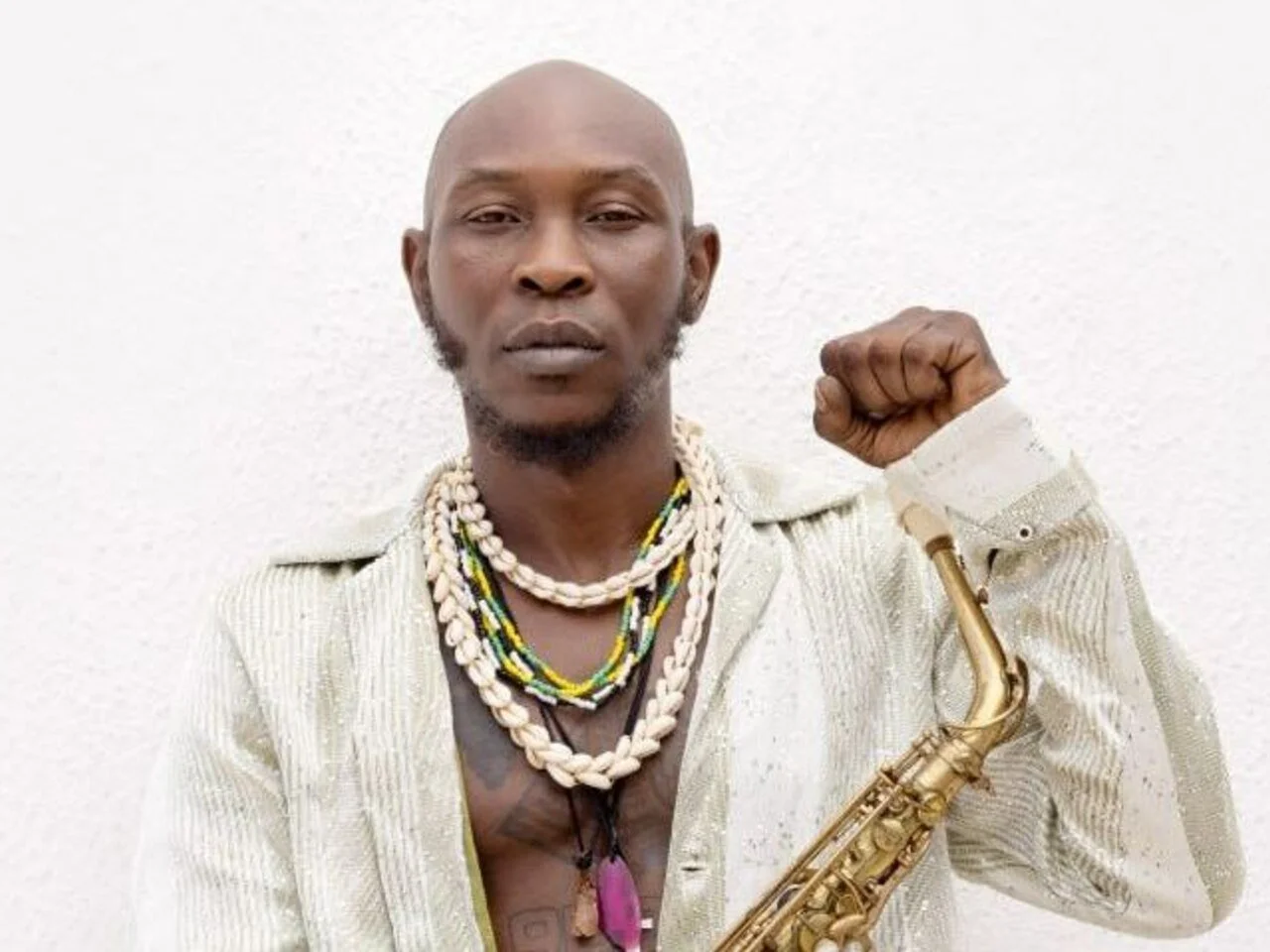
Seun Kuti; Source: Instagram
I. Introduction
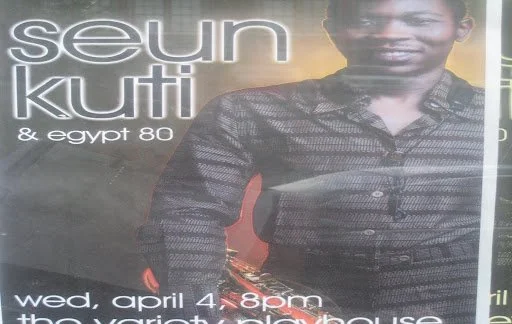
After a 10-hour drive from their Chicago performance, Seun Kuti & Egypt 80 arrived to the Variety Playhouse Theatre in Atlanta, Georgia’s Little Five Points District. Giving only 14 days of advance notice to the people of Atlanta, Seun Kuti, one progeny of the late, famous Fela Anikulapo Kuti, perhaps inadvertently put up a challenge against other much publicized music venues in the city that evening. Nevertheless, Seun Kuti & Egypt 80 had much of a diverse following that night. Given the short-noticed event and immediate name recognition, there was over-browed curiosity of Seun Kuti. In spite of succeeding the leadership of his father’s original band, Egypt 80, Seun Kuti’s US’ presence appeared to be understated but apparently intimate. His overseas significance - greater in demand - travels through the receptive ears of some in the United States by way of word of mention, virtual media, and of course, through his father’s and older brother’s name sake, respectively – Fela and Femi, another much admired and experimental Afrobeat artist. His 2012 world music tour would be the first time that the US is added to the schedule. Seun would also have the favorable recognition of the highly rated Broadway musical depiction of his father, Fela!. There may be banality but also pragmatism to attempt to fit the challenge of living up to the high-blowing notes of the elder saxophonist to his lesser-famous, younger son, Seun. The overall thesis is to analyze the sounds, behavior and political concepts of Seun Kuti and Egypt 80’s musical performances within the framework of the Afrobeat genre. However, even in the conceptual study of Seun’s music, vicarious supporting details of Fela and his founding of Afrobeat are also deeply concentrated on to assist in capturing the core and soul of Seun and his band.
In many of his interviews, Seun usually considers his father at the starting point; inspiration and an initial segue into his journey of the Afrobeat genre. His father had multiple saxophones but brought a new one home to eight years-old Seun after noticing how strong of an interest he took the instrument. Fela’s only prerequisite for Seun was to be classically trained on the piano for 5 years and then he would be able to progress to another instrument. There isn’t any available insight on the reason of these set of instructions or whether if Fela also began on the piano at Trinity College in London, United Kingdom. Alas, Seun’s goal came to fruition as he matured to the saxophone by default in honor of his father. At the age of 14, Seun’s succession of Egypt 80 after Fela’s untimely death further surmises Seun’s envisioned manifestation of his father under the continued legacy of Afrobeat. He’s noted for once saying, "When I listen to my music and my father's music, it's a continuation of something original."
Large, Olde English font letters, “Fela Lives”, is permanently branded on the upper portion of his back as a symbol of honor for his father. Unlike his older brother- Femi, Seun willingly accepted the challenge of being compared to his father. At one reflection, he states, "Being Fela's son shaped my ideas and who I am. I accepted that a long time ago. It's very important to know who you are, but even more important is being able to accept it." This statement by Seun significantly encapsulates the aforesaid, to know who Fela is subsequently gives meaning into knowing who Seun is. Therefore, the question that bears to ask, who is Fela Anikulapo Kuti?
Again, who is Fela Anikulapo Kuti? He is a formally trained Nigerian musician that’s most famous for the founding of Afrobeat. Before he found his successful formula with Afrobeat, Fela experimented and released music under the 1960’s contemporaries of high-life, modern jazz and then a hybridized version of the two - “High-Life Jazz”. However, very rarely stated, Fela was of a privileged class in contrast to many in Nigeria. His western focused musical exploration – European brass influences of High-Life and Black American revival of Modern Jazz - during the last throes of the British colonial system over his country was evident of his bourgeoisie status. Paradoxically, High-Life was popular during the colonial rule period and during the post-colonial Nigerian Civil War. It was music of strong, celebrated, stage-front brass winds with upbeat, effervescent percussion rhythms. However, the more favorable elasticity and consumptive behaviors of music by the elite classes of the country indexed to an optimistically, detached class irreverent of the oppressed conditions of Nigeria. As well, the popularity of High-Life may also suggest the music’s temporary emotional reprieve from a colonized reality; a cultural resilience. African-American jazz received very little movement from Africa during the 1960’s and 1970’s post-colonial period. Mr. Kuti found it to be exceptional having studied the ingenuity of the modern jazz musicians. His opportunity to sonically experience Miles Davis, John Coltrane and Charlie Parker was a musical rebirth for Mr. Kuti incorporating the saxophone as a major in his music. He also found influence in the jazz funk sounds from Herbie Hancock and James Brown’s R&B funk downbeat on the first quarter note of a three-quarter meter. A confluence of each cultural study and musical instrument assisted Fela in his maturation of Afrobeat but not to the exclusion of a deep, social awakening of the civil rights movement in America. He found there to be a culture of resistance from African-Americans that was integrative from the likes of many types of artists, academics, religious organizations, etc. Fela’s actual turning point was with his personal relationship with former Black Panther Sandra Izadore and of his learning of Malcolm X’s teachings, a fervent civil rights leader. The studying of both allowed him to re-connect to his African history and cultural memory after a long suffering of European colonization. He concluded, “I must clear myself from this mess. I must identify with Africa. Then I will have an identity. It is my desire to create a new trend worthy of emulation in the music scene of this country in particular and Africa in general, which will be a pride to the black race”. Thus, entered the era of Afrobeat, a musical genre that consist of several textures of brass horns, various percussion systems, bass strings, indigenous rhythms and vocal chords with a political consistency. Fela moved the people of Africa, as well as, internationally through his music for over 30 years and posthumously. However, his music was met with both political and physical resistance from his own national government. In “Original Sufferhead”, he attempted to awaken the consciousness of the masses to their own self-realization of their suffering under the auspices of governmental policies and corporate economic development nefariousness. Fela chants to the people of his country in a call and response rhythmic meters, “Don’t turn us to slaves. It’s time for jeffahead. It’s time for our liberation. Me I say sufferhead must go. I say our suffering must end”. He never received any media sponsorship of his music. The lyrics were considered to be strong enough to elicit some form of censorship by the government by even violent means. In 1997, Fela Kuti died of AIDS complications. His immortalization in Africa can be regarded to close similarities to the late Robert Nesta Marley of Kingston, Jamaica. Hence, the order of magnitude projected onto Seun Kuti’s appropriation of his father’s legacy. The following presents analyizes Seun Kuti’s approach to co-maintaining the artistry of Fela while simultaneously asserting his actual resilience, creativity and physical standing on stage and the proverbial bully pulpit.
II. Research Methodology
With limited material engagements on Seun Kuti, research methodology practices on Seun Kuti and Egypt 80 were a bit challenging. The considered approach was to carefully not obscure from Seun’s own inherent presence with various methodical research that included the study of Fela. The research of Fela, however, was utilized to capture the relativeness and nuances between him and his father that Seun, in his own right, speaks to.
Initial research was conducted on the father, Fela Kuti, from a biographical resource, Arrest the Music! Fela and his Rebel Art and Politics, by Tejamola Olaniyan. This e-book was utilized because the convictions and politics surrounding Fela’s music were maintained as the centered-focus instead of an intangible romanticism of the artist. The core of what was to be sought out in this book was his family and kinship values surrounding music and politics, economic and academic standing during and post-colonization, documentation of his journey in discovering Afrobeat, as well as, uncover all of his musical and political influences. The final considerations would seek to make connections to any traditions, revitalizations carried through Seun.
The instrumentation of Afrobeat music speaks with clarity and execution, however, it was actually the lyrical content of the Afrobeat pioneer that had struck a discord with the Nigerian government. In a pre-analysis of the lyrical content of Seun Kuti relative to his father’s, the method was to ascertain the depth and consistency of Seun’s core messages relative to Fela’s, the creativity of linguistic tools used to speak to his audience and, of course, if the band deviated from the duration length of the songs that Fela was adamant in maintaining. Most of the lyrics were found utilizing google.com search engine resulting in the highest relevancy at afrobeatmusic.net.
Video and audio recorded interviews were researched to capture an upfront and personable impression of Seun relative to Fela. Also, using video and/or audio interviews as part of the research is to the benefit of mitigating the nuances and partiality that are sometimes trapped within the text of print journalism. Relevant and historic videos of both Fela and Seun are contained in the registers of youtube.com. An approximate nine minute video interview was conducted by John Yearwood of the Miami Herald News as a promotional response to Seun Kuti’s latest album release, From Africa with Fury: Rise, in Summer 2011. Also, Music is the Weapon is a 53-minute direct interview documentary with Fela Kuti that was recorded in 1982. The documentary was part of a 2-cd/1-dvd album package, The Best of Fela Kuti: Music is the Weapon- an independent purchase.
Pre-recorded performances of Seun Kuti and the band were utilized, as well. The purpose was to obtain a pre-analysis of the band’s stage presence and energy, observe the performing instruments for further research and to pre-identify each member for further research. As well, the performances were reviewed to analyze the dynamics and relativeness to Fela Kuti’s overly confident stage presence. One observed youtube.com video was a fifteen minute outside performance of Seun Kuti and band in Amsterdam, Netherlands during their Summer 2011 tour. Various performances over the career span of Fela Kuti are well documented within the registers of youtube.com.
In addition to reviewing previously recorded interviews and performances in youtube.com, the comments section is a very integrative system that allows networking and interactive responses on the subject video. The comments section has surveying capabilities in gauging specific remarks and times of relevancy of subject video. Toggle buttons with “thumbs-up” and “thumbs-down” icons signifying subscribers rewarding the video with a favorably-high mark or punishing the video with an unfavorable mark. The features served a benefit from a statistical analysis on sampling Seun Kuti and Egypt 80’s fanfare worldwide.
As such with his father, the music of the younger Kuti is used as a vehicle for political resistance for the masses. How effective have the merits of such a movement been? What responsibility does Kuti personally accept in leading such a movement through lyrical awareness? What political immersion into an actual activity has Seun Kuti engaged in? Library resources and internet research of current affair materials were utilized in seeking such information. Email contact was also attempted to the entities sponsoring Seun Kuti and Egypt 80’s concert to secure an interview or an indirect remote Q&A, but to no avail.
The most direct methodology conducted was on the evening of the actual concert of Seun Kuti and Egypt 80. Direct contact with members of the band was made prior to the concert but an actual interview didn’t present itself; pictures were taken. Fellow concert attendees were randomly surveyed on their thoughts and purpose of the band.
III. Analysis
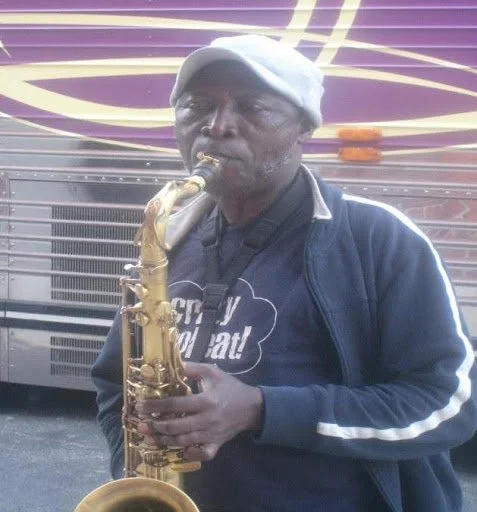
band member of Egypt 80 outside Variety Playhouse, Atlanta, GA
.
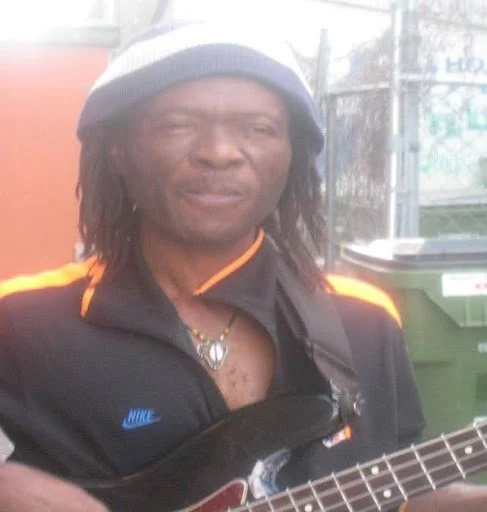
band member of Egypt 80 outside Variety Playhouse, Atlanta, GA
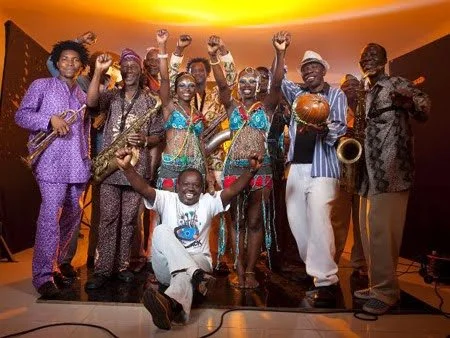
Egypt 80 (Seun Kuti band and formerly of Fela Kuti);
Source: Live Rock Festival
The collectivity of the Afrobeat band makes up (15) members and (18) instruments: extra-large dununba drum, 5-piece drum set, African congas, (2) lead guitars, bass guitar, shekeres, keyboard, (2) alto saxophone, tenor saxophone, baritone saxophone, (2) trumpet, wood block instrument, lead vocals, (2) backup vocals/dancers. The unity of their Afrobeat sound is characteristically polyphonic in texture. Stylistically sound, the instrumental melody of the brass wind instruments loops with the melody of the guitars but not competitively suppressing the mood of the other instruments, perhaps standing as a countermelody. Unlike in most western popular music, the brass winds instruments are very interactive in the soul of Afrobeat; not serving as just background ornamentation. This assertion serves as an index reference to the historical context of Fela Kuti’s incorporating horns into the West African soundscape. Primarily performed songs, the keyboard and regular guitar carried the harmonies, regulating the rhythms of the bass guitar and consenting to the beats of the drums and ornamentation of the wood block and shekeres.
In the opening of the show, Egypt 80 performed the instrumental of “African Soldiers”, while awaiting Seun’s stage presence in standard fashion. The lead guitar initiated with fast stroke rhythms. The strokes are so fast that rest intervals are completely oblivious, if subtle. The wood block instrument then inserts into the instrumental with a casual clucking - two one-half notes per measure. The fast rhythms of the guitar are very spellbinding and emphatic, that the movement of the congas, drum-set and shekeres are very ambiguous. The guitar and percussion instrumentals consumes the audience for the first forty seconds of the song, until the trumpet plays asserts itself as the lead for approximate thirty seconds until the saxophones adjoin and blend into the air. As the horns become more complicated in texture, the bass guitar assumes a role in a more defining sound of the rhythm. The congas and 5-piece drums become more announced. The keyboard is very inconspicuously but it’s serving its purpose harmoniously. The instrumentals remain interactive until the brass players yield to only one solo horn at a time; this alters the horn texture and tone to the integrity of the specific horn in lead. The baritone saxophone is distinguishably much lower in pitch and timbre than other saxophone and trumpets. The instrumental warm-up eventually concludes as a signal for Seun Kuti’s stage entrance.
By tradition, Seun Kuti’s first performance honors his father by performing Fela’s original, “Zombie”. It’s a homophonic performance with the vocals of Seun dominating the accompaniment of the back-up singers. The vocal format is almost in a lining out style as the rhyme scheme expresses a natural space in the phrases where Seun rests but the back-up singers interject synchronously. Of course, with the upbeat of the music, the transition is very smooth. As per usual, in parts of the song, he relents and yields to the multiple horns. The song finalizes with a solo saxophone.
The group apparently knew which song to perform as the introduction. On “African Soldier”, the quick loops of the guitar rhythms are very gravitating in conjunction with the steady clucking of the wood block intervals. The overall theatre is dim lit but the stage lighting is very bright and appealing like a bright star at night. At the Variety Playhouse, there’s approximate twenty-five foot clearance between the stage and the audience seating so that the fans could either dance or embrace the front of the stage near their artists. The movement of the audience towards the stage during the introduction song expressed like vulnerable components in an electromagnetic field.
The group was very engaging with all sounds of instruments. Thus, the audience was very engaged with positive feedback of irresistible dancing, whistles, cheers, clapping and other favorable gestures. Lots of money is thrown on stage by many fans as a symbol of appreciation for the band to share their artistry. It is presumed that they were acts expressed by native Africans with upheld Eastern traditions in the audience. This doesn’t appear to be a Western custom; gestures of hand movement, flowers thrown on stage or lit cigarette lighters may have more familiarity among Americans. However, Seun did intimate in one interview that it is an African tradition to reward your favorite musical band by throwing money on the stage. During an interlude, Seun intimates his position of one’s natural right to marijuana use which is a segue to “The Good Leaf”, a song that appeals to the governmental powers to decriminalize the marijuana plant. He introduces his audience to be a part of the song by participating in the chants, “Plant-the-seed-and-let-it-grow” in a rehearsal form. Part of this performing act ended in symbolism with Seun using a full bottle of water to splash on the floor of the stage. The symbol is the source of water as sustenance to life and natural society; a symbol of liberation; cultivation of resistance; or “growing” out of inorganic mental or political restraint. The performance left the audience very hyped. In dry humor, the sudden aroma of burning marijuana isn’t too ironic for a band unapologetic for its rebellious politics.
Seun does seem to be redeeming himself to the musical challenges of Fela Kuti and his oldest brother, Femi. In the aforementioned, Fela’s formula of Afrobeat was incomplete without a social conscious, self-awareness, and political activism. Seun’s boldness and dereliction to those of corrupted powers have been expressed defiantly. In January 2012, Nigerians rose to counter the President’s act to remove government oil subsidies. Seun led some efforts in Occupy Nigeria to rally the masses of people to resist this policy. He was recorded as saying, "I'm not talking economics here. I'm just talking common sense”. "You cannot charge $1 a litre when the [majority of the] population lives on less than a dollar a day." Even though some expressed concern for the consequential danger of his life; to be so vocally against the Nigerian government just like his father, he doesn’t appear to be frightened from government retribution. He was old enough to observe the violent attacks against his father by earlier governments and even in the military’s murdering of his grandmother. He’s been on record saying,"What the Nigerian authorities should understand is that when you knock one person down, someone else will take up the torch."
A curious statement made by Seun in an interview: He too doesn’t get much media sponsorship or national recognition from officials because of his anti-establishment music and his natural inheritance from his father. He eluded that it was an attempt to demote his power to enact change among common people. However, as an artist, Seun and Egypt 80 received a high recognition with the request for him to perform at the Nobel Peace Prize Award ceremony in 2008. It’s inconclusive whether establishment officials felt any threat or containment to deny Seun the opportunity to perform live in front of many international dignitaries considering his defying words against western powers, as well. Nevertheless, Seun and his group seized to the opportunity to use the institution as place to present his platform globally. During their performance on stage, Seun appealed that international aid isn’t needed in Africa. Justly, this position has been intimated by many who have positively sincere interests of the people of Africa. International aid has been regarded as the structural racism and economic culprit that had stricken many previous governments from inserting polices that would benefit their people. Seun makes his point in an interview with Afrobeat.com, “Afrobeat is about the development of Africa properly. Not industrial development. You have to get the foundation and the basics set. It is the African people that can carry Africa. Even if the African people are weak, what strength can they use to carry Africa? So right now we have an Africa that is being carried by Europe and America, on aid, so-called aid that is actually kickbacks for being able to exploit the continent. They have been giving aid to Africa since the 70s, and they have been increasing by two-hundred percent almost every year.”
IV. Conclusion
Seun’s courage and challenge to continue his father’s legacy is intimated in more ways than one. His musical brilliance, creativity and energy to electrify the stage with the original Egypt 80 need no further argument. His thoughtfulness to lift the torch and keep progressing through his music and rebellious politics are tangible and well-spoken for.

V. Bibliography
-The Music of Africa; J.H. Kwabena Nketia; W.W. Norton & Company, Inc., New York, 1974
-Arrest the Music! : Fela and His Rebel Art and Politics; Olaniyan, Tejumola; Indiana University Press; 2004
-“Seun Kuti on FELA!”; Interview by Banning Eyre; New York City; 2009, http://afropop.org/multi/interview/ID/169/Seun%20Kuti%20Contemplates%20FELA%20on%20Broadway
- “Seun Kuti & Egypt 80”; THOMAS FAWCETT, 2012, http://www.austinchronicle.com/music/2012-03-16/seun-kuti-and-egypt-80
-Seun Kuti & Egypt80 performing live at the Nobel peace prize concert 2008http://www.youtube.com/watch?v=TcXkAQcQXXA&feature=related
-The Music of Africa; J.H. Kwabena Nketia; W.W. Norton & Company, Inc., New York, 1974
-Arrest the Music! : Felaand His Rebel Art and Politics; Olaniyan, Tejumola; Indiana University Press; 2004
-“Seun Kuti on FELA!”; Interview by Banning Eyre; New York City; 2009
http://afropop.org/multi/interview/ID/169/Seun%20Kuti%20Contemplates%20FELA%20on%20Broadway
- “Seun Kuti & Egypt 80”; THOMAS FAWCETT, 2012
http://www.austinchronicle.com/music/2012-03-16/seun-kuti-and-egypt-80
-Seun Kuti & Egypt 80 performing live at the Nobel peace prize concert 2008http://www.youtube.com/watch?v=TcXkAQcQXXA&feature=related