Great Zimbabwe: From Novelty to Silencing the Sacredness (2013)
©2026 Barbara Columbus
Introduction
This report reviews the common features, historical narratives and past and living entities within the country of Zimbabwe, Africa. The evaluation of the current geography, natural resources and economy of the country helps to draw a connection to the politics, impositions including liberation struggles. The brief review of the ethnicity, language and religion of the people of Zimbabwe may give inference to the functionalities, powers, priorities or lack thereof within the country. The historical text of Chimurenga revolutionary songs, soapstone birds and land reform all draws the past forward to still relevance. This research recognizes the strong connection to sacred concepts and the spiritual world certain groups in the country have. While the site of Great Zimbabwe is generally reviewed as an archaeological feature, national monument or a registered feature on the World Heritage list, social anthropologist Joost Fontein cites the marginalized narratives of the traditionalists that remember the site as a past living sacredness and medium that was connected to the spirit ancestors but has since been commodified, desecrated and silenced. In addition, marginalized war veterans and revolutionaries are still seeking class liberation from an elitist, nationalist African government. Fontein finds that they have made a re-alliance with spirit mediums to reconnect with the spirit world for purposes of a revolution – as they attempted in the first and second Chimurengas against the white colonial rule. The anthropologist seems to make a connection with all of the marginalized entities.
Geography, Natural Resources, and Economy
Referenced from 2002, the Republic of Zimbabwe had an approximate area surface coverage of 150,873 square miles with approximately 12 million people in total population.
It is geographically located in the southern region of Africa centered between neighboring countries Zambia, Mozambique, South Africa and Botswana. With an approximate population of 1.6 million people, Harare is the capital city and commercial and economic hub of the country. The country is managed by eight major administrative provinces regionally: Manicaland in the east; Mashonaland East, Mashonaland Central, and Mashonaland West in the north; Matabeleland North in the west; Matabeleland South and Masvingo in the south; and Midlands in the center. The soil consistency of the subtropical environment varies with two thirds of land being suitable for cultivation; the most fertile soil covers the northern area of the country – Highveld. The less than rich soil is located in the southern end of the country – Lowveld, which has an approximate 2000 feet above sea level difference with the Highvelds (Owomoyela 2002:1-6).
Seventy-five percent of Zimbabweans rely on agriculture for a living. Crops such as corn, sugarcane, wheat, cotton, soy, tobacco account for one-eighth of the country’s GDP and a 40% return on exports. Tobacco is one of the top foreign exchange generators. Much of the agricultural industry produces from large plantations sourced in the most fertile areas and owned by whites – which are less than 1% of population. The dichotomy is that the less desirable land which is disproportionately less in size, productivity and economic access is utilized by indigenous African farmers, the majority and original descendants of Zimbabwe. This current reality carries a legacy of racism and European colonization discussed further in subsequent sections of this research. In regards to mineral resources, gold is still the most abundant of the mineral resources. Mining accounts for about 1/12th of the GDP and employs about 1/28th of the labor force (Owomoyela 2002:4-6).
Ethnicity, Language, and Religion
The Shona ethnic group makes up 71% of population. They are largely a patrilineal society of farmers (with the exception of the Tonga Korekore subgroup) that reside mainly in the eastern parts of the country, north of the Lundi River. The Shona language is recognized under six main dialects and subgroups: Karanga, Zezuru, Manyika, Tonga Korekore (matrilineal), Rowzi, and Ndau. They practice a monotheistic worship of Mwari as their Supreme Being, as well as, sorcery and channeling of ancestors through spirit mediums. Mwari is considered as an original ancestor, not as the creator; but as the primary of all creation. He is depicted as a spirit voice from the sky - Soko which means “voice” or “word”. Ndebele pastoralists, predominantly located in the southwestern area of the Zimbabwe near Bulawayo, is populated at 16%. This group also has a presence located in northern South Africa and eastern Botswana. Nguni is the language of the Ndebele, and perhaps because of their close proximity in space, the language is also mutually intelligible with the Zulu tongue of South Africa. Because of their intermixing with the Shona, they also adopted Mwari as their deity of worship. Other portions of the Black population make up 11%; which are affiliated with the Balonka, Shangane and Venda. The remaining 2% of the population is Asian, mixed and white. Overall, in the ranking between 40 – 50% of religious worshipping, Christianity is the main religion of practice among all the ethnic groups (Owomoyela 2002:9-11).
Art and Liberation: Chimurenga and Soapstone Bird Sculptures
Chimurenga is a music genre in Southern Africa that is most popularly known to be influenced by Zimbabwe contemporary artist, Thomas Mapfumo. Culturally, it is a blending of traditional music, electronic instrumentation and political/social commentary (Owomoyela 2002:142-143). However, the music actually manifested from the impoverished guerrilla camps in Zambia and Mozambique that were set up for the Zimbabwe African National Liberation Army in 1976 (Pfuka 2008:30). The genre name is derived in Shona language meaning "uprise" or "revolutionary struggle" which is symbolically referent to the liberation struggles of indigenous Africans against the white colonial settlers in Zimbabwe (Owomoyela 2002:142-143).
The Chimurenga narratives in the camps were all oral for security reasons; however, they would eventually become codified and culturally popularized within the Africa milieu (Pfuka 2008:49). In the service of the cause, the lyrics of old church tunes were substituted with new texts and were altered in the meaning and references aimed at the white settlers (Owomoyela 2002:142-143). The songs largely were ideological and psychological purposed to motivate the soldiers during their struggle for liberation (Pfuka 2008:33). One such set of lyrics is from the guerrilla war song “Kanyau” (derivative from Portuguese term “canhao” which means 75 mm recoilless rifle): “It has roared / Let’s go / The recoilless has roared / It has roared / Let’s go too / To Zimbabwe / The recoilless rifle has roared / Let us go / The recoilless rifle has roared.” This song is said to summons young people to arm themselves against the white settlers (Pfuka 2008:45).
Zimbabwe is also recognized for their sculpture traditions. In particular, soapstone birds were found at the ruins of Great Zimbabwe, which later became the national emblem (Owomoyela 2002:61). Not only do the birds express significance for the sacred and physical representations at Great Zimbabwe, but their symbolism as the national emblem of the country is referential of Zimbabwe’s independence from colonialism. The birds have been historically documented of their disappearance from the Great Zimbabwe site during the colonial period – late 19th century - and their return to Zimbabwe at the point of Zimbabwe’s independence – early 1980’s (Fontein 2006:782)
Historical Events – Prehistory to Chimurenga to Zimbabwe State
Inhabitation in this area predates to 8000 BC by San hunters and gathers, as evidenced by various rock paintings enshrined of religious entities. By 200 BC, the Khoi-Khoi maintained the area through sedentary and farming practices. By A.D. 300, migrants carrying the Bantu language and skills of iron tool-making were discovered in the area. The people in this area also subsisted from cattle ranching, gold mining, jewelry-making and carvings just to name a few (Owomoyela 2002:13). European visitors were attracted to the area due to the rumors of abundances of gold in the region, as well, as to aspire to thoughts of creating a Cape-to-Cairo railway. In 1891, British settlers gained control over a European entity trading company which led to the colonization of the Zimbabwean population. A “hut tax” was imposed on Africans as a device to force them into laboring for the settlers. While their enticement to this area was largely inspired by gold, the colonizers also gravitated to farming and ranching - stealing and removing the Ndebele from their land. They gained control of the most fertile land and areas that had a good rainfall and drainage system, which was located in between Harare and Butare. Blacks were pushed into the driest, infested, and less desirable Middleveld and Lowveld areas.
The Shona and Ndebele, once rivals, joined forces in 1896 to "rise up", also known as “Chimurenga”, against the white colonizers. It ended a year later, with the capture and death of a Shona leader. A few decades later in the 1930s, the colonial office established a racist, self-governing, whites-only parliament. They enforced a strict segregation policy between Blacks and Whites in the colony similar to South Africa’s apartheid and the U.S. Jim Crow segregation laws. Accordingly, the British government passed the Land Apportionment Act of 1930. Throughout all of this time, Africans were continuing to resist and form organizations. The second Chimurenga took place in 1966 to oust whites. To attempt to maintain power amidst the aggression from Blacks, the white regime instituted another partition referred to as the Land Tenure Act of 1969. It basically superseded previous land apportionments but giving exactly half of the land to whites (approximately 250,000 in population.), and the other half (mostly infertile) to Africans (approximately 5 million population). To qualm down the conflict in this area, members of the African resistance and white colonial government met with the British PM at the Lancaster House Conference in 1979 to formulate an agreement. All parties conceded to a constitution that protected 20 of 100 parliament seats to whites, as well as, protection of their land. The country of Zimbabwe officially became independent from white colonial rule in 1980. Robert Mugabe, new Prime Minister, took office and adopted a moderate approach by accepting whites into his cabinet to allay concerns to the international community and for the country’s economic security. As of 1990, there was still very little reprieve for the common Black Zimbabweans. War veterans in guerilla warfare groups were still activating in resistance (Owomoyela 2002:14-22). Their motivation was to remove both colonial and capitalist structures. (Sadomba 2013:108) Whereas Mugabe personally identified as a Marxist, but his new black majority government still maintained the same economic structural system and political practices as his white, colonial predecessors (Owomoyela 2002:21). According to Sadomba (2013:108), Mugabe was interested in eliminating colonial rule; however, he has taken to maintaining capitalist rule and relations, contrary to his prior promulgations. Sadomba (2013:108), quotes, “to the marginalized working classes and war veterans, racial dominance and oppression was replaced by elite dominance and oppression, thereby setting a perfect condition for neocolonialism. ’The actual revolution was not completed’ but ‘interrupted’; and the economy was not democratized, but remained governed by elite-settler capitalist relations.” However, both Fontein (2006:238) and Sadomba (2013:88) suggest that Mugabe perhaps took for granted and used the vulnerable concerns of the war veterans regarding land reform as political capital against white farmers. At the behest of the war veterans, Mugabe began to reconsider the land rights privileges that were stipulated for whites from the Lancaster House constitution, which would expire in its tenth anniversary in the1990’s (Sadomba 2013:84) (Owomoyela 2002:22-24). The 20 seat reservation to whites in parliament had been removed from the constitution in 1998. Prior to 2000 elections, black war veterans took occupation of white-owned farms in reclamation of their ancestor’s stolen land, then validated by the Rural Land Occupiers Act ( Owomoyela 2002:22-24) (Sadomba 2013:84). There was also an economic crisis that was further impacted by Zimbabwe’s assistance in intervening in the violence in the Democratic Republic Congo. Commercial farmers laid off more than 300,000 workers causing the country to import 600,000 tons of maize. With further exacerbations, the United States’ senate imposed on Zimbabwe’s affairs by enforcing travel and economic sanctions against country (Owomoyela 2002:23-24). In the late 2000’s – post-independence – the struggles have been more about class and less about race as it seems that Mugabe and the African nationalist elite are allied with white elite settlers and international capital. Mugabe’s alliances with African revolutionaries and war veterans are timely, short-lived and used for political expediency as evidenced by the 2005 elections (Sadomba 2013:106-110). As of today, there are speculations and theories waiting to settle and solidify the narrative on Robert Mugabe’s legacy as he still holds office in his third decade. After spending three years in Zimbabwe studying the political dynamics and nature of the president, Ghanaian-born filmmaker Roy Agyemang has produced a yet-to-be released a documentary on Robert Mugabe, “Mugabe: Villain or Hero?” His inspiration for the film was to remove the negative filters from western, propagandized media and independently study whether the Zimbabwe president was as evil as suggested (Dalby 2013:72). Agyemang (Dalby 2013:72) says that Mugabe seemed to be an amenable leader but there is general fear from his supporters that the country is losing its “control to neocolonialist forces intent on controlling its natural resources”. The review of the film notes the commentary of a Zimbabwe woman in the film as she praises the president, “Any other country that had gone through what we had gone through would have experienced civil war but here we have a man who has stood up against all and all, and said ‘Zimbabwe for the Zimbabweans’.” As far as the verdict of his legacy, Agyemang says “Time will tell”. (Dalby 2013:72)
Re-alliance of Spirit Mediums, War Veterans and Revolutionaries
As far as for the revolutionaries and war veterans, Sadomba (2013:110) hypothesize that the realization of a full Zimbabwe revolution may depend on a strategy beyond the existing neocolonial impasse. In 2006, Joost Fontein focused on the war veterans re-approach - since the second Chimurenga - of forming alliances and co-opting the traditionalists language and the spiritual authority of their ancestors, spirit mediums, chieftaincies and other African traditionalists for the purpose of realigning their local legitimacy, as well as, recognizing the ancestral ownership of the land (Fontein 2006:233-239) This gives such implications of the particular power and guidance that spirit mediums and other traditionalists may have in the state in spite of their appeal to reclaim the sacredness of the Great Zimbabwe site (Fontein 2006:786). It was President Mugabe that summoned spirit mediums to invoke rain during a drought; most of them declined due to his ignoring them on other matters such as the governments commodification and alienation of Great Zimbabwe (Fontein 2006:234) (Fontein 2006:786).
Great Zimbabwe: From Novelty to Silencing the Sacredness
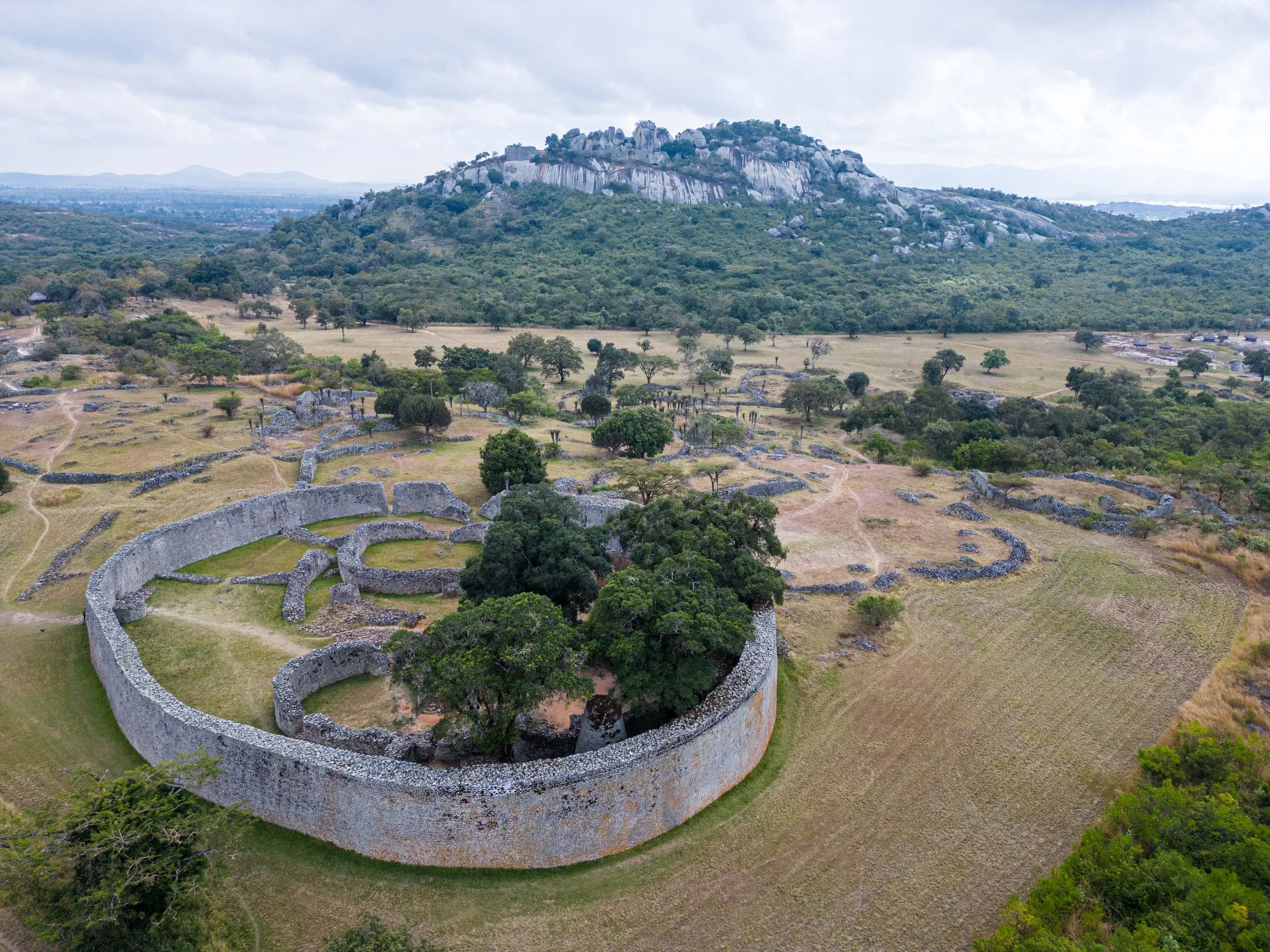
Great Zimbabwe was a royal city built between the 11th – 15th century. The etymology for "Zimbabwe" is Shona in origin, deriving from “dzimba dza mabwe” (great stone houses) or “dzimbawoye” (esteemed houses). During these periods, the population held between 10,000 and 20,000 people. The primary inhabitants during that time are considered to be the ancestors of the present day Shona group. Archaeology findings traced the ancestry to a Bantu connection and/or the Rozwi (or Rozvi) cultural group (Owomoyela 2002:12). The populations assumed dominance and superiority not by force but by organization; the discipline and integrity of the rock structures being as evidence. It is believed that they coexisted peacefully without dislocation alongside other pre-colonial immigrants. The roofless structures were perhaps evidence of their needless security or lack of aggression. Researchers concluded that the structures served as a purpose of honoring the rulers (Owomoyela 2002:13). The stone monument spread approximately 1800 acres; the site is 155 miles south of the capital city of Harare (Owomoyela 2002:12). Gold and copper were still a primary resource in the earlier centuries influencing the zeal for trade along the Swahili coast. Imports from India like glass beads, cloth and porcelain were also valued. It was the lavished stories heard about the abundant reserves that lured the Europeans to this particular area. The influence at this site had declined in the 15th century due to land depletion, internal conflicts or the overall decline of east African trading cities. By the time that Europeans had reached this specific point in the late 16th century, the activity was non-existent. Europeans eventually redirected their energy to agriculture in the area. (Owomoyela 2002:13).
Today, local communities stand at conflict with the state of Great Zimbabwe with direct indexical points to sacredness and the past. Joost Fontein, a social anthropology professor at the University of Edinburgh in the United Kingdom, had conducted an ethnography based on spirit mediums and two local, rivaling clans – Mugabe and Nemanwa - regarding their concerns on the “silence”, “destruction” and “closure” of the site. He wanted to know the various forms of silencing that the communities were distressed about. Great Zimbabwe has a vast history and it has been narrated from many voices and pretenses of authorities, however, the local “voices” and communities are concerned that the rightful owners and guardians of the site – Mwari and spirit ancestors – are not respected and nor remembered in their proper places. Antiquarians of previous centuries lured to explore this site not only caused destruction due to digging but also denied the considerations that Africans could skillfully build the structures. However, archeologists refuted the claims of the antiquarians through the modes of the “scientific method” and language of “objectivity”. While both disciplines attempted to play in a position of intellectual authority to represent the past of the African site even as both viewpoints stood diabolically opposed to one another, the local narratives of the indigenous depicted them all as the same. They both were viewed as desecrating the site by both clan groups (Fontein 2006:771-773). Through their sense of authority to represent the past for the Africans, Fontein (2006:773-774) suggests that it actually silenced the agency of the indigenous and the sacredness of the ancestral space itself. Furthermore, the onset of damages from the white colonizers, the indigenous contestations of ownership of the site and the government’s site management and commodification also objectified and buried the underlying element of Great Zimbabwe: the sacredness. Fontein captures the concepts of sacredness and silence by learning about the sacred landscapes; dissipating sounds and voices; silence of resistances; destruction, thievery and looting; and closure, appropriation and alienation (Fontein 2006:771-773).
The community’s connection with Mwari, their ancestors and the rest of spirit world draws to their spiritual attachment to the land. The Mugabe and Nemanwa clans both consider Great Zimbabwe as a sacred site due to their respect and worship of their past ancestors who are “buried” or “germinated” within the landscape. It is their” link with the past” that makes it sacred. Present inhabitants are referred to as "child of the soil". Mwari and the ancestors are viewed as “owners and guardians” of their descendants and the land. They are respected for their functions during their struggles for independence and their overall conservation and maintenance of the land. The site is to embody the meeting of both the social and spiritual world which is realized through the sacred practices and ceremonies performed on ground. This gives important insight into the community’s opposition towards the perceived desecration of Great Zimbabwe. (Fontein 2006:773-776).
The local community of Great Zimbabwe spoke to Joost Fontein about the silenced voices and noises or rather the sounds that no longer exist in the area since the colonizers arrived. In his cited interviews (2006:776), the members took account of past memories of the numerous sounds that used to come from the site. They were voices and sounds of the ancestors emanating from the site. They historically spoke of the sounds of milking cows, grinding corn, whistling and drumming. (Fontein 2006:776)
The sacredness of the site was to remain suspended by angered spirits until they feel respected again and the rules and customs are abided. Fontein takes account (2006:778) of Ambuya VaZarira, a spirit medium, on the notion that the spirits develop a silence of resistance that is manifested from their anger of the desecration of the historical space. This is said to be an indication of the punishment towards those that act against the site (Fontein 2006:779). Ambuya suggested (2006:779) evidence of this silent resistance by way of an environmental disaster she witnessed, “Great Zimbabwe got burnt. The spirits told the Ministers, that the mountain at Great Zimbabwe would catch fire…because they have failed to abide by the rules of the stones. And of course, the fire broke out, and the mountain was burnt, but they could not stop the fire by any means.”
The desecration of the site is said to be largely attributed to the Europeans’ aggravation of the space in the 19th century. Their lure for precious treasures created disruption and physical destruction as they negligently used explosives and machines to search beneath the earth’s surface. However, they couldn’t find anything. This was suggested to be another expressive form of silent resistance and by the powers of the spirits to remove the gold from being accessible to the looters. It was noted that the colonizers also disturbed and removed recent graves in search of wealth. The symbolic soapstone bird sculptures that were mounted at the site were also missing for quite a few decades. The image of the bird was codified as the national emblem at the time of independence after a set of the sculptures was returned in 1980. Another set was returned in 2003 by a museum located in Berlin, Germany. (Fontein 2006:780-785)
Great Zimbabwe had long become an object of appropriation and commodification. Not only are the white colonials apportioned to some blame but so is the current government. The National Museum and Monuments of Zimbabwe has oversight over the area. In terms of tourism, one of the members of the clan had suggested that the spirits are “happy to have visitors”. Therefore, it’s not so much that foreign voyaging of the area is a problem; however, it is the perceived lack of respect towards the spirits that is a concern such as fencing, tourist fees, signs, buildings, tour pathways, inappropriate dressing, couples kissing, or the unsustainable items left behind at the site by tourists. Entry fees and fences are recognized as seizing of the ownership and power of the site – away from the ancestors (Fontein 2006:785-787).
Ambuya VaZarira, the spirit medium, suggested (Fontein 2006:786) that she and the entry clerk had a confrontation over her refusal to pay an entry fee; it had angered the ancestors and may have evoked some retribution towards the clerk. The following week the entry clerk had died.
The spirit mediums’ power is not just automatically realized by way of their ancestors solely by their status. It is through the power and performance of ceremonies. The sacredness of the site isn’t fully realized unless through performance and practices. (Fontein 2006:775). It is through ceremonies that the war veterans and spirit mediums seek to settle the spirits of the dead guerilla fighters at Great Zimbabwe (Fontein 2006:233). However, by the powers of the National Museum and Monument of Zimbabwe, ceremonies at the site are restricted. In that effect, it denies the communication between indigenous, material world and the spirits. A few have been held in secret. The local clans strongly believe that if ceremonies and offerings given to the spirits as done during the first and second Chimurenga, the sacredness would return (Fontein 2006:787-788). The overall sacred concerns have been addressed to the NMMZ. In recent years, museum management has been attempting to reconcile the concerns of the indigenous by recognizing the living sacredness of the site, however, the museum still maintains control. One of the indigenous leaders denies the claims made by the NMMZ suggesting that the site could never return to its spiritual value unless it is turned over and retained by its traditional custodian, the indigenous. (Fontein 2006:788)
Conclusion
This report recounts many aspects of Zimbabwe from the country’s geography to the liberation struggle against colonialism. Joost Fontein recounts a different narrative from the traditionalist clans in the local, traditionalist community near the desecrated and silenced Great Zimbabwe. He doesn’t specifically mention it, but because the state’s control over the state and the concerns of the communities don’t seem to be prioritized over the commodity value of Great Zimbabwe, the site seems to be a colonized space. Thus, the re-energized efforts of war veterans and revolutionaries to co-opt traditionalist worshipping may not be realized without the sacred space of Great Zimbabwe fully restored and recognized.
References
Dalby, Alexa
2013 Mugabe Villain or Hero? African Business (394):72-73.
Fontein, Joost
2006 Languages of Land, Water and 'Tradition' Around Lake Mutirikwi in Southern Zimbabwe. The Journal of Modern African Studies (2):223.
Fontein, Joost
2006 Silence, Destruction and Closure at Great Zimbabwe: Local Narratives of Desecration and Alienation. Journal of Southern African Studies 32(4):771-794.
Owomoyela, Oyekan
2002 Culture and Customs of Zimbabwe: Greenwood Press.
Pfukwa, Charles,
2008 Black September et al: Chimurenga Songs as Historical Narratives in the Zimbabwean Liberation War. Muziki: Journal of Music Research in Africa 5(1):30.
Sadomba, Zvakanyorwa Wilbert
A Decade of Zimbabwe’s Land Revolution: The Politics of the War Veteran Vanguard.