Evolving Through the Cultural Memory of the Original Blues Woman (2013)
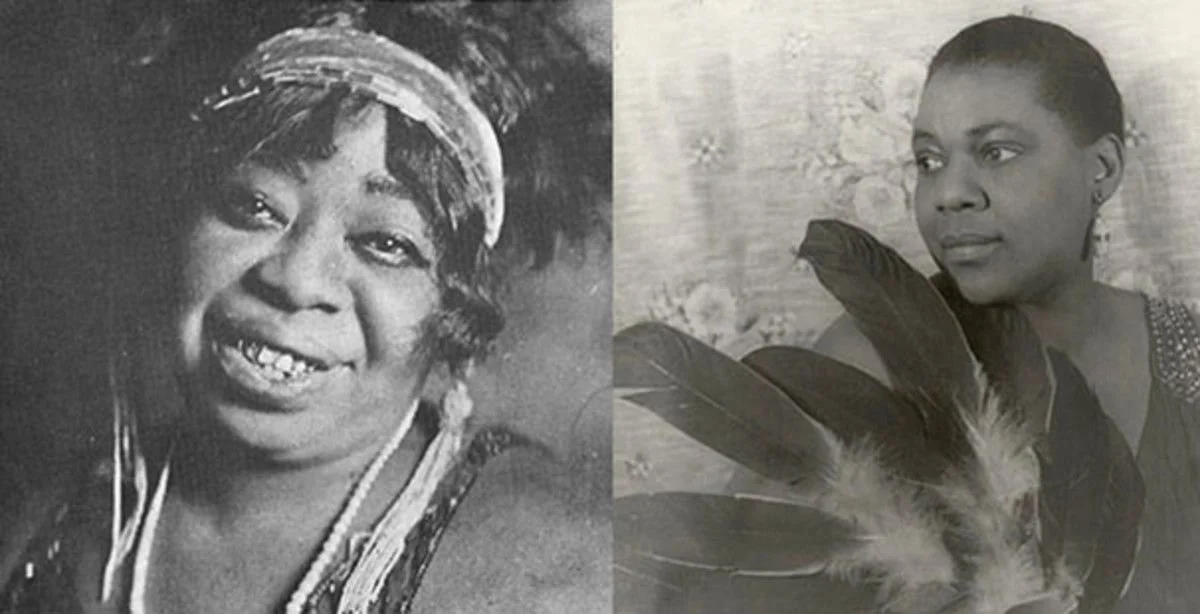
Original Blues Women
Ma Rainey (1923); Bessie Smith (1936)
©2026 Barbara Columbus
Valerie June, a Southern roots musical artist, attempts to authenticate her sound to those of her southern indigenous roots in the Mississippi deltas and Tennessee’s Appalachians. There’s so much simplicity and clarity in her sound but many complexities in her narratives. Angela Davis’ book, “Blues Legacies and Black Feminism”, helped me to appreciate and understand the constructed spaces and human experiences from which the Blues art form derived and as lyrically voiced by the Blueswoman. Davis theorizes that aside from the patriarchal lens that focused on the Bluesman’s story, the Blueswoman – being the first to record in the genre in the early 20th century – played a major part in navigating the social consciousness of Blacks in post-slavery United States including a few Black intellectuals such as Langston Hughes and Zora Neale Hurston. Dr. Davis became more informed of these women’s own black feminist impressions, as defined through their own terms, expressing intersecting concepts of racial, gender and class oppression inflicted on them in early 20th century society. Dr. Davis analyzed the resonating songs that detailed the very constricted spaces that poor and working class Black women steered; songs with musical themes of love and heartache, poverty, domestic violence, sexuality and gender expression, women advisement and empowerment (xi – xvii).Using Dr. Davis’ Black feminist thought on the Blueswomen, I narratively speak on my initial discovery of Valerie June to evolving on her music through her musical aesthetics, ideas on post-blackness and her social consciousness on women’s roles and same-gender equality in the 21st century. But most importantly within all of this, I analyze how June’s own musical aesthetics, personal experiences and socio-political consciousness seem to carry a cultural memory from the traditional Blueswoman of the early 20th century.
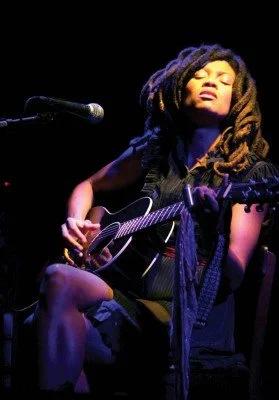
Roots Music Singer, Valerie June
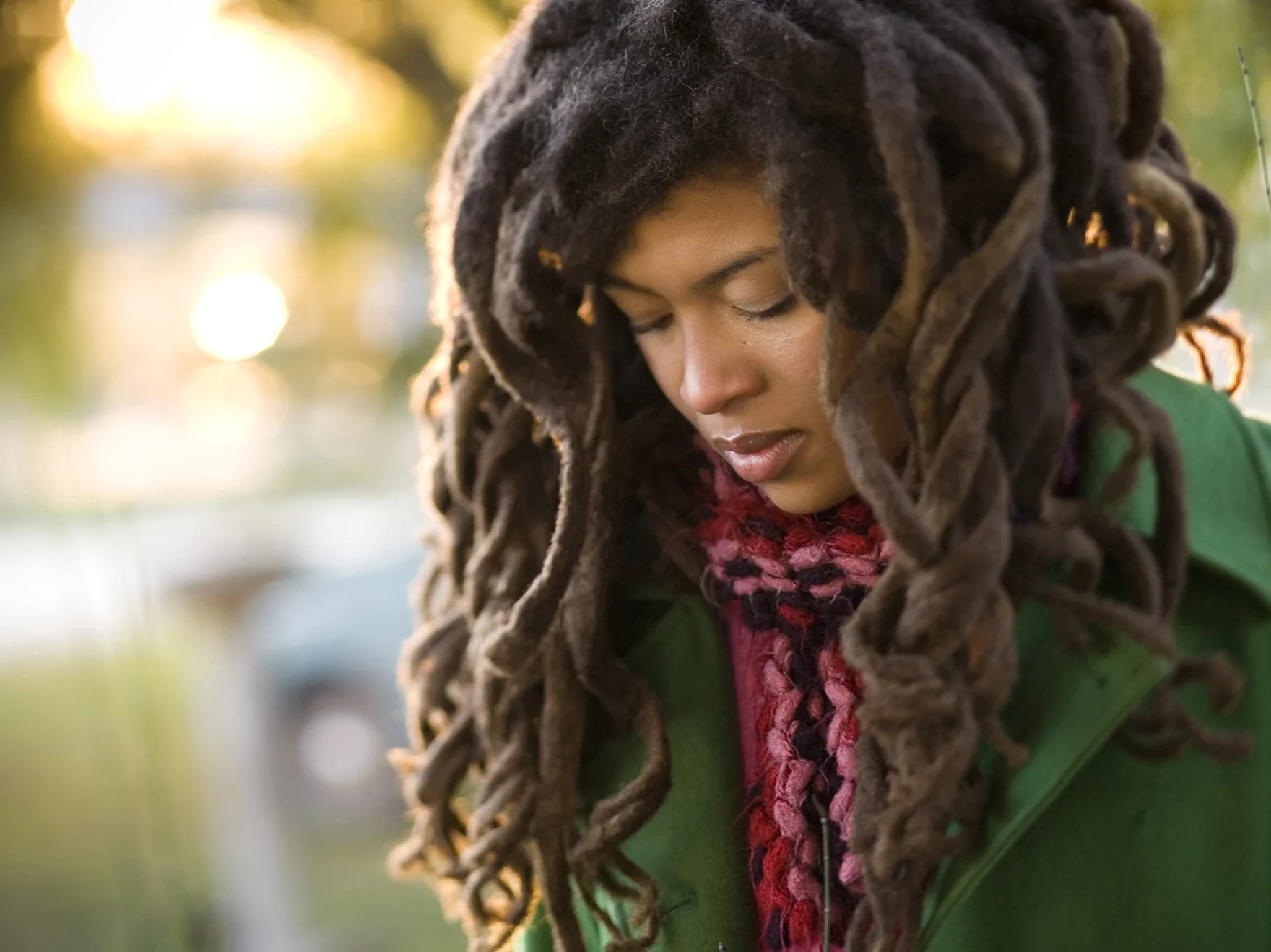
Roots Music Singer, Valerie June
In my initial discovery of Valerie June, she was only a passing image of a young, black woman with rich, woolen-like, free-forming locks on a social media site . I remember expressing adoration for her hair, which appears to be an important accessory to her personality. On my first impression of her music, I found June’s southern folksy style relatively unorthodox and appealing. She has a deep, twist and turn, southern twang that she proudly owns in her songs. Her style wanders outside of the mainstream pop culture realm that re-creates and embellishes social realities with glamour, gaudiness and other imaginaries. June’s music backdrop seems like a small, intimate coffeehouse or a deconstructed mojo house situated somewhere in Tennessee. Her only accompaniment to her vocals is acoustic strings and soft foot tapping.
I think only because of her hair and texture of her voice, some reviewers like to compare Valerie June to contemporary music artist Erykah Badu but the two couldn’t be any more different, spiritually and aesthetically. The awkwardness about her was that I didn’t know how to fit her into a categorical box, musically. She had an unique space in between my India Arie and Fiona Apple set. June identifies as a Black woman and I conveniently wanted to add her neatly under the Blues or Folk music label even though I perceived just as much Bluegrass and even Country notes strumming in between the spaces of her melodies and thumb strokes of her ukulele, banjo or acoustic guitar instruments. I blame my typifying on the Western conventional thought that likes to explain human experiences by compartmentalizing them into variable constructed spaces. But holistically acknowledging that Blues music is a historical root of many genres is pertinent in the trajectory of American culture. June broadly identifies her music as “organic moonshine roots music” to attribute her deep influence to the indigenous form and aesthetics of her progenitors such as Elizabeth Cotton, Jessie Mae Hemphill and even Dolly Parton (memphisflyer.com). Some of her songs are themed in love and estrangement, hope and despair, sexual agency and liberation, freedom of gender expression, betrayal and murder; just to name a few.
“Workin’ Woman Blues” is broadly a depiction of feminist class resistance. It is also a song of internal and external social struggles, epiphany and hope. At the opening of the song, June is already at a turning point where she realizes that her life is far from happiness and comfort. In the first four lines, she exclaims, “I ain't fit to be no mother/ I ain't fit to be no wife / I've been workin' like a man, y’all / I've been workin' all my life.” It is a self-empowering moment because she reaches an epiphany that the 21st century societal role that is expected of her as a woman - a single mother, wedded mother, wife, personal domestic servant, as well as, a laborer for her employer - is quite over-demanding and yet unfulfilling to her own dreams.
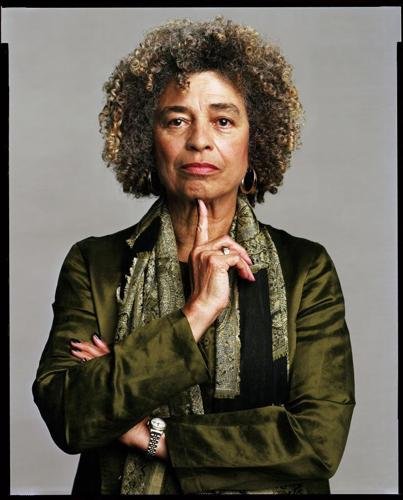
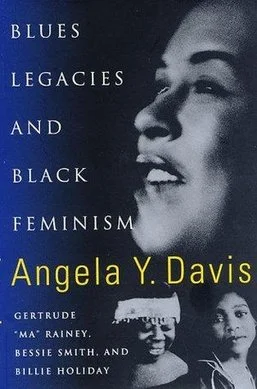
Blues Legacies and Black Feminism book by Dr. Angela Davis
As a Black contemporary feminist, Angela Davis recognizes that the story of the early 20th century Blueswoman is that of a Black working class woman’s struggle; a narrative that white women and middle class black women couldn’t particularly relate to. Post-slavery, most black women were still expected to fulfill dualistic duties as a domestic servant and also the same duties as black men such as field work. So when Valerie June sings throughout the song that she’s been “workin’ like a man”, she’s making a subtle historical reference and irony. The irony being that men are generally physically larger; therefore, the roles that women have historically performed must be relatively weaker in capacity. The underlay is that she’s deliberately contradicting the sexist idea that men’s roles are more heavy duty and laborious by highlighting that her own duties – as a single mother, wedded mother, wife, personal domestic servant and wage worker with very little compensation - never ends at the end of the day.
“Workin’ Woman Blues” is a feminist piece but it is not a narrative that exemplifies every woman’s story. In reality, this particular woman’s story is layered very much with class and race complexities in the current social landscape. Valerie June talks publicly about how she had to hold multiple, low-level, laborious jobs to survive. At times, she wondered if her situation would remain a long-term fate (cmtedge.com). Creating from her own personal story, June conceptually formed what Angela Davis referred to as the “politicization of the ‘personal’ through the dynamic of ‘consciousness-raising’” (42). But also, “Workin’ Woman Blues” has a collective voice that stands independent of the “individual narrator”. It conceptually reminds me of Bessie Smith’s “Washwoman’s Blues” where she sings about her exhausting work duty to wash the clothes of wealthy white people in order to economically survive. It may not have been Smith’s direct personal narrative but it was a reflection of the socio-economic misery that Black women endured during that time. With indirect contestation for the suffering of these women, Bessie Smith illuminated the gendering collective social problems by rendering them as the ‘blues’ through her performance of the song (Davis, 98-102). “Workin’ Woman Blues”, too, has the collective power of articulation that “Washwoman’s Blues” had. Even though Valerie June doesn’t explicitly racialize her lyrics, in this current social world it is primarily black women and other women of color that are inflicted by an unfair hierarchical economic market and, thus, experience the “workin’ woman blues” (americanprogress.org).
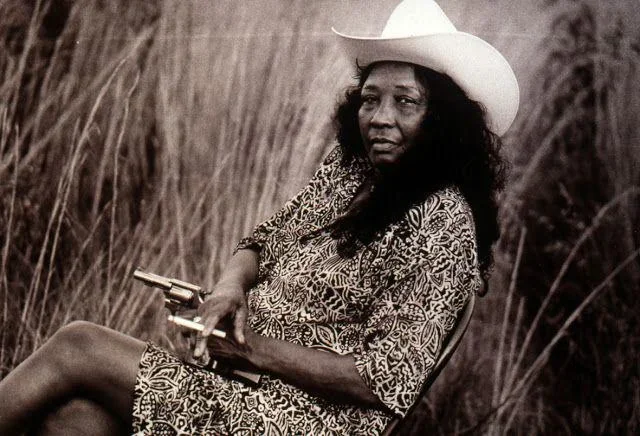
Blueswoman Jessie Mae Hemphill
Image Source: chordify.com
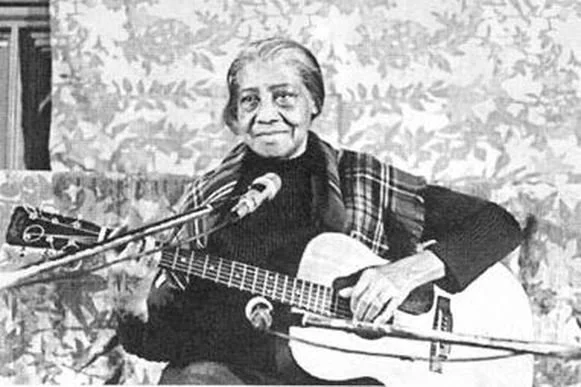
Blueswoman Elizabeth “Libby” Cotton
Image source: Sooze Blues & Jazz
I’ve never particularly moved within the country music world. But, ironically, my favorite song on Valerie June’s album is “Twined & Twisted”, a simple country ballad. With very little musical production – only the organic strings of a guitar – she sings a very personal story. She’s grappling to find her place in a world bounded by restricted ideas and contradictions. She begins the song very introspectively. Although June's soul-searching offers very little resolve and optimism, she reservedly presses forward in her worldly battles because she has no other choice. In the second and third stanza, she sings, “Said got no place in this world / Shackle bound, but still I roam / Runnin’ from my family / Driftin’ from my home / Thinkin’ not of who I am / Thinkin’ only of where I’m going.” It reflects ideas on her self- identity. In previous interviews, June has pondered over not wanting her political identity as a Black American woman to dictate authority over her self-identity. Valerie June muses within the politics of post-blackness to escape the singular idea of a black identity. In the attempt to constrict her, she indicated people don’t think that there’s resonance or a market for her particular black musical aesthetics and blend of music. She stated, "I knew people wanted me to do the neo-soul thing, but, like always, it was just about the color of my skin. That was a time when that style was blowing up and everyone was into Jill Scott and Erykah Badu, and that's what everyone wanted me to sound like." "I think it's hard for people to understand what I do because of the skin I'm in.” "Bands like the Civil Wars and Alabama Shakes — the music matches the image (memphisflyer.com). Her sentiment reminds me of a recent lecture given by Curator Thelma Golden on post-black art where she discussed opening the space for Black artists to move freely and unbounded by post-civil rights black aesthetics. Alas, such values of artistic space and limitations seem to have conceptually been debated since the origin of Blues.
Although, the 1920s Blueswoman didn’t directly engage in social protest about black women’s oppression, they utilized musical devices such as call-and-response to construct the personal as political by affirming the experiences of her women audience and making it a conscious raising experience. Angela Davis analysis of passing call-and-response concepts into the postmodern world as a “conscious-raising strategy” to inform on women’s oppression is evident of the Blueswoman’s historical influence on the politics against male supremacy (54-57). Recently, Valerie June and Meshell N’degeocello covered as a duo, “Be My Husband”, Nina Simone’s 1960s Blues protest original, styled in a call-and-response form.
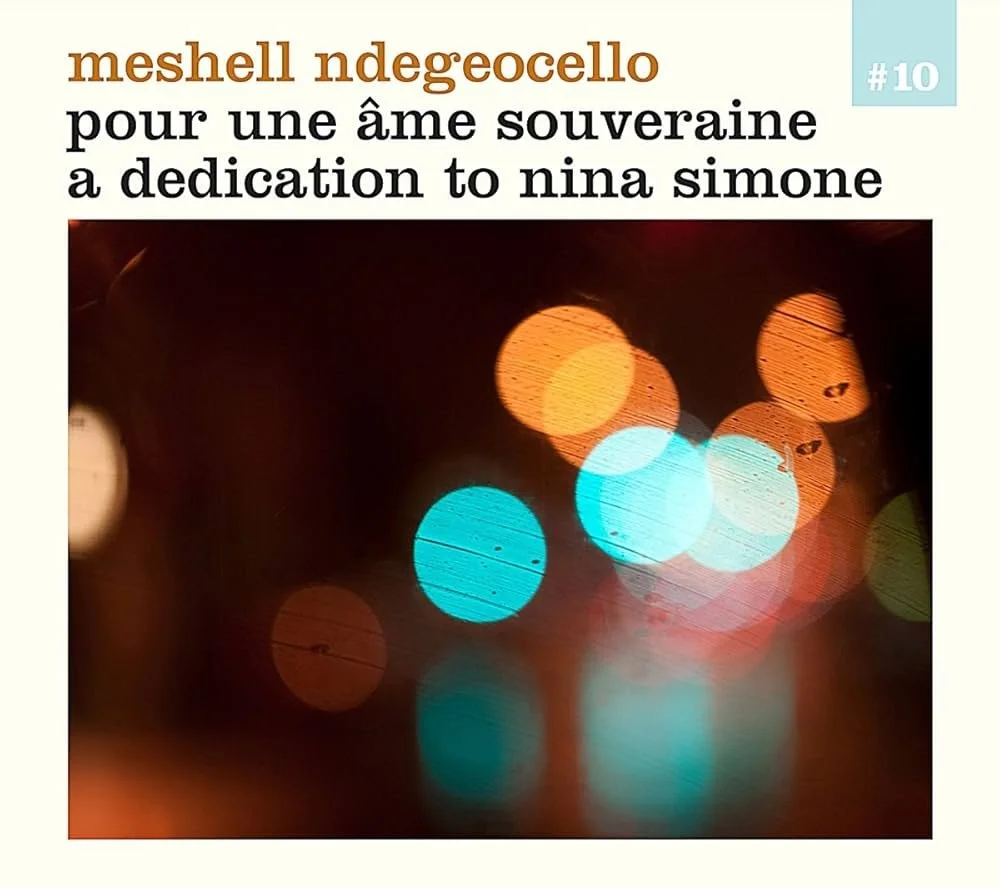
Meshell Ndegeocello’s 2012 album: Pour une Âme Souveraine: A Dedication to Nina Simone
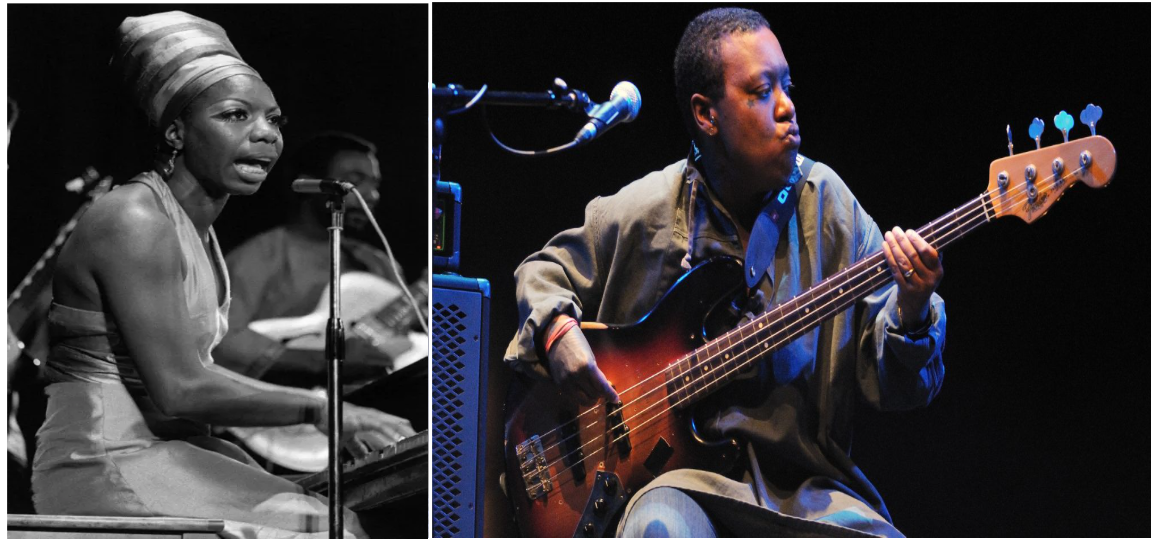
Jazz/Blues Woman Nina Simone;
Singer/Bassist Meshell NDegeocello
I was excited that June and N’degeocello were engaging in a heavy challenge to re-imagine Nina Simone’s social and artistic consciousness. In the protest song, “Be My Husband”, Ms. Simone is appealing to her husband for reciprocity for her love and respect. As she articulates the call-and-response form in the public, it politically connotes a challenge to male supremacy and the dualism of marriage roles in the 1960s. The message is also confluent within the energy of both the Civil Rights and Women’s liberation movement. In the latest rendition, Valerie June performs all of the vocals and hand-clapping in the call-and-response tradition; Meshell N’degeocello performs on the bass guitar. The two re-imagines the song as a declaration of same-gender love and an appeal to redefine the institution of marriage to same-gender couples. In this method, the original articulation is re-used as a rejection of patriarchy, heterosexism and submissiveness. The only change in the structure of the song is in the lyrics of the fourth line, originally sung as “Love and honor you the rest of your life”. It’s been edited to “Loving all of you the rest of your life”, to remove a submissive tone between two equal beings. The concepts in the song run parallel with some of the songs written and performed by Blueswomen Ma’ Rainey and Bessie Smith. In their songs, neither woman conformed to society’s gender construction or heterosexuality. They challenged ideas on love and sexuality in their songs by showing contradictions on the representations of traditionalism, as June and N’degeocello had also attempted to address in “Be My Husband” (Davis, 41). The selection of this song by them couldn’t have been any more deliberate. In the current political environment, same-gender rights are one of most important civil rights issues of this era. June uses her voice to express her solidarity with same-gender activists. N’degeocello is a long-time declared same-gender attracted woman and overall human rights activist, as her music reflects. June and N’degeocello both seem so much alike philosophically because they seem to appreciate music or even the world as one; not through segmentation (thethread.dukeperformances.duke.edu). Nina Simone was never a stranger to civil rights activism. Even Bessie Smith used her artistry to unify the racial and male supremacist struggles between the new Black migrants in the North and those in the South. Angela Davis noted that her songs assisted to create new consciousness on black identity by promoting “unity and heterogeneity of the black experience” (89-90). In that regards, Valerie June and Meshell N’degeocello’s social and artistic consciousness are evolutionary products of Ms. Simone’s, Bessie Smith’s, Ma’ Rainey’s, etc.
I evolved on Valerie June’s music from my initial discovery of her and throughout a whole year until her first studio album was released. It was not the genre labels that appealed to her. It was the blending aesthetics of her sound and the thoughtful socio-political ideas that she grown into developed from her own personal experiences as a Black woman in the US. It was the phenomenon that she seemed to still carry cultural evidence of the super dynamics of 20th century traditional Blues Woman.
Works Cited
Davis, Angela Y. Blues Legacies and Black Feminism: Gertrude" Ma" Rainey, Bessie Smith, and Billie Holiday. Random House Digital, Inc., 1999.
Herrington, Chris. memphisflyer.com. September 27, 2013 2013. <http://www.memphisflyer.com/memphis/pushin-through/Content?oid=3484412>.
Hight, Jewly. cmtedge.com. September 27, 2013 2013. <http://www.cmtedge.com/2013/08/22/valerie-june-carves-her-tennessee-roots-in-stone/>.
Howe, Don. dukeperformances.duke.edu. August 9, 2013 2013. <http://thethread.dukeperformances.duke.edu/2012/10/interview-meshell-ndegeocello-honors-nina-simone/>.
Kerby, Sophia. americanprogress.org. September 27, 2013 2013. <http://www.americanprogress.org/issues/labor/report/2013/04/09/59731/how-pay-inequity-hurts-women-of-color/>.
Wilcox, Don. americanbluesscene.com. August 18, 2013 2013. <http://www.americanbluesscene.com/2013/08/my-time-after-while-the-rise-of-valerie-june/>.