Pedagogy of the Rhythm: From Senegal to Guerrero, Mexico (2026)
©2026 Barbara Columbus
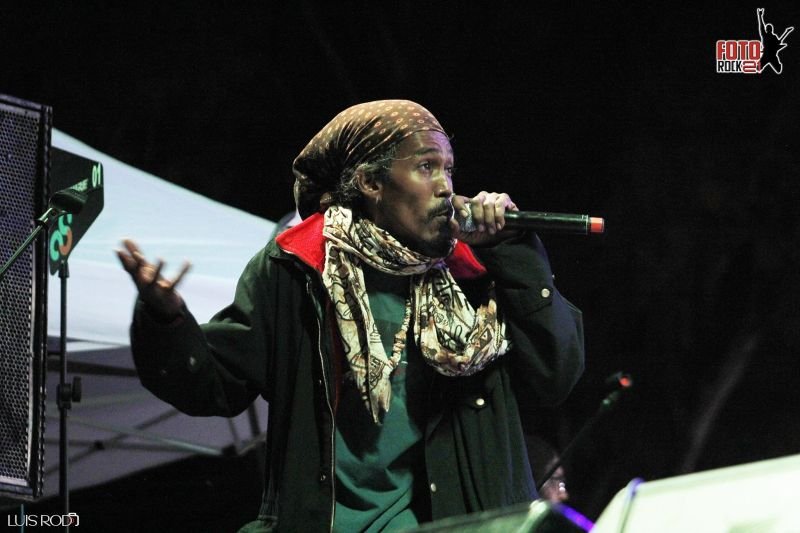
MC Youalli G (Photo Credit youallig.com)
Afro-Mexican History
The history and narrative of the Afro-Mexican community is interesting and important to learn, as their existence in Mexico was not widely familiar. In recent decades the community started to receive more acknowledgement of their current presence and historical past. However, this has not been easily attributed to without the communities’ demand of constitutional rights and visibility. Social appeals and campaigns for the constitutional rights of the community began in the late 1990s. The population was officially and formally recognized in the Mexican national constitution in 2019, which purpose is to provide them cultural visibility and possible social resources. Also, the constitution was bound to sanction against racism or social marginalization; whereas, prior to 2019, the group did not legally exist.
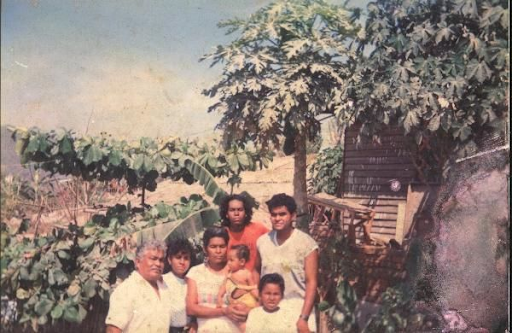
MC Youalli G & Family (Photo Credit: youallig.com)
José García Torres (aka “Yo MC Youalli G”)
But, the narrative of this article pans in and focuses individually on the work of Afro-Mexican Hip-Hop Music Artist and Composer José García Torres (aka “Yo MC Youalli G”), who has been creating music since the late 1980s. Youalli is a music artist that’s originally from Acapulco, Guerrero, currently lives in Zihuatanejo, Guerrero and with familial roots in Ciruelo, Oaxaca, Costa Chica. He is recognized as one of the foundations of the hip-hop movement in Mexico. In 1988, he adapted the term R.A.P. as “Ritmar Adaptando Palabras” (translated Rhythm Adapting Words). He’s been a long representative of the TribuSURbanas (Urban Tribes of Guerrero), a non-profit collective of like-minded artists that collaborate, perform, and promote their cultural movement and social events in Mexico (Garcia 2026). In our initial 2016 meeting, he spoke extensively about the cultural history of the Afro-Mexican people. He enlightened me on the ancestral past that extends back centuries in Mexico - including the past systemic racism and politics that affected the population’s lived experience. His perspective was very encouraging as he offered a lot of optimism with respect to the constructiveness of the contemporary Afro-Mexican “Reconocimiento” social movement and the overall trajectory of the community.
More recently, I met with him again in late 2025 for a formal interview via Zoom. In the interview, we talked about more history, his cultural identity, childhood, political thought, music including his musical influences and critiques, and spirituality. While the discussion was scheduled for an one hour, semi-structured interview format, it extended beyond the timeframe because he had many thoughtful revelations and passionate ideas to share. His expressions flowed methodically and engaging like a teacher but also creatively like an artist. In this article, I explore the concept of his work as being both the teacher and artist by identifying with African oral traditions and contemplating the ancient history and cultural role of griots. I also use writer Dee Williams’ correlation to hip-hop’s linguistic aesthetic with Paulo Freire’s critical methods in Pedagogy of the Oppressed.
African Oral Traditions in Latin America/Caribbean
Writer Kubayanda studied the contributions and passages of African oral traditions to Latin American/Caribbean literature and cultural space. African drumming, song, dance and music has been imparted into the cultural milieu of the Americas by way of slavery, colonization and cultural acculturation. As well, in terms of literature, Kubayanda (1984:5) states “...one can no longer make a competent reading of certain Latin American and Caribbean texts without a reference to the African oral-traditional legacies of discourse about the world. … that many "African" variables underpin the creative writing of the New World from Barbados and Brazil to Cuba and Colombia...” Kubayanda utilizes (1984: 5) the work of Barbadian writer Edward Brathwaite that identifies four significant categories of Caribbean literature that re-members African oratures: (1) African rhetoric, (2) African survivals, (3) expressions, and (4) reappropriation. He cites (1984: 7- 9) examples of African survivals and ideophonic linguistics in the writings of Venezuelan writer Juan Pablo Sojo’s Nochebuena Negra. He also analyzed (1984: 9) African oral rhetoric and heroic lore with connections to Mandingo (Mali, Songhai) and Bantu (Central and South Africa) culture in Ecuadorian Adalberto Ortiz’s Juyungo and Panamanian writer Carlos Guillermo Wilson’s Chombo. (Kubayanda, 1984).
Negro Guerrero:
I requested listening reviews from a few U.S. friends and associates on Youalli’s 2008 hip-hop song, “Negro Guerrero”. For the most part, they appreciated the rhythm, lyrical flow, and intonation in his voice. Certainly, in the video presentation of “Negro Guerrero”, the artist celebrates Afro-Indigenous Mexican rhythm and energy that's rooted from his Indigenous, African and Spanish ancestral traditions. But also, in the power of language, the reviews would suggest that he is a really nice lyricist that sounds most potent in the Spanish language of thought. “Negro Guerrero” is a song that narrates and reveres the identity, history, ancestral leadership, material culture, and resilience of the coastal communities of Guerrero, Mexico. If one wanted to learn or gain a brief highlight about Costeños (coastal people of Guerrero state), they would be immersed in the song and music video, “Negro Guerrero”. In this video, Youalli is naturally the griot or historian of his community. The song and video also colorfully and vividly captures the material culture of the community; be it “... iguanas … pescado…or …el mar..” (Garcia 2008). I refer to Youalli as a cultural griot, a West African cultural derivative, because of the richness in his creative expressions and cultural narrations with a strong sense of the immediate socio-cultural environment and the global landscape. Griot is a member of a community that engages as a musician, teacher, or oral preservationist of history. Within many groups in Senegal, griots have always been significantly esteemed and recognized for their methods to teach and preserve the cultural memory through spoken word, music, instrumentation, dance, etc. (Nikiprowetzky 1963) (Stoller 1994). Furthermore, other researchers like Daniel Banks have drawn the trajectory from ancient griots of West Africa to the original form of hip-hop (Banks 2010). He says (2010: 240) similar to the ancient “...oral artists, the emcee also tells of his community's issues, its values, its ancestors, its heroes and heroines, its triumphs, and its struggles- "imparting lessons of social and political history". That’s exactly what Youalli is revealing in his hip-hop song “Negro Guerrero” and many of his other hip-hop songs. The term “Guerrero” is a reference and revelation of the political history of the state of Guerrero in Mexico. It’s a call to reverence to Former President Vincente Guerrero, the second elected president of the country and military leader in Mexico’s War of Independence with Spain. President Guerrero was also of both Indigenous and Black cultural identity and fought for progressive rights for the people of Mexico against Spain. (Vincent 2001) Yoalli’s third entendre on the use of “Negro Guerrero” is it’s underlying meaning: Black Warrior. The different usages and meanings of the term “Negro Guerrero” is an evolution of the other. (Garcia 2008)
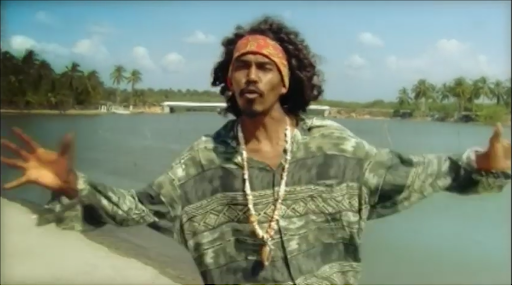
Photo Credit: “Negro Guerrero” video screenshot
“Negro Guerrero"
I come from the state of Guerrero, a warrior.
I project what I think, and I stand by what I say.
I arrive and set things on fire with my rhythm and style,
charged with energy... right now.
(snip)
My heart is where I speak from
And wherever I go, I carry my flame,
The rhythm of the Cumbia and the Chilean cueca.
So much deep-rooted Blackness
Facing the blue sea and beneath the mountain.
(Translated Lyrics Excerpt) (Garcia 2008)
In the song, he also makes reference to his identity, cultural genealogy and Mexico’s colonial history of the region; thus informing listeners of the cultural syncretization of his African, Indigenous and Spanish heritage. The song is a transformative statement of strength, empowerment and celebration of his cultural body; not misery nor inferiority. And this is the energy that extends outward to his community and outside listeners. (Garcia 2008)
Somos Los Mismos:
In Youalli’s hip-hop song, “Somos Los Mismos”, he presents a more serious, critical and political thought. It’s a critique against systemic police violence. It’s an attempt to awaken the authority on the other side and question where truly lies their best interests rather than serving in the illusions of power. (Garcia 2015)
“Somos los Mismos”
And you silence me with gunfire, because you forget,
that in the game of interests we're on the same page,
and we're cannon fodder, and if we confront each other,
it will be like killing each other as brothers.
(Snip)
And the thing is, I learned to read before I learned to shoot,
that's why I'm telling you we can talk
and avoid conflict between our peoples,
we are the same, I remind you.
(Translated Lyrics Excerpt) (García 2015)
This critique form of Youalli’s is central to the purpose of hip-hop and oral arts dating back to ancient West Africa (Banks 2010) (Nikiprowetzky 1963). Aside from the inevitable rhythm and movement of “Somos Los Mismos”, writer Dee Williams relates the creative, critical linguistic and authentic expressions in hip-hop art to the critical language theory that Paulo Freire espoused as a pedagogical tool for the development of a culture of resistance and liberation in communities. She’s suggesting that Freire’s work set a trajectory that found its methods in the economically oppressed spaces that hip-hop developed and evolved in. Freire used critical language and social theory to critique and transform external social systems in Brazil but also to manifest spiritual growth and empowerment. Similar to Youalli’s “Somos Los Mismos”, hip-hop has traditionally used these methods to empower their communities through their authentic and creative spoken word.
This has been a review of José “MC Youalli G” García Torres’ works as an artist and, theoretically, a teacher. The role and purpose of a cultural griot was explored in the context of the hip-hop artist’s songs. “Negro Guerrero” and “Somos los Mismos”. In addition, his hip-hop aesthetic of language was explored in the context of Paulo Freire’s critical language theory in Pedagogy of the Oppressed.
Barbara Columbus has an M.A. in Public Anthropology from American University, Washington D.C. Her subject interests are identity, race, indigeneity, cultural sustainability/preservation, material culture and political economy.
References
Banks, Daniel
2010
From Homer to Hip Hop: Orature and Griots, Ancient and Present. Classical World 103(2): 238–245. https://muse.jhu.edu/article/376243
Columbus, Barbara, and García Torres, José
2025a
On the Concept of Hip-Hop Song, “Negro Guerrero.” Zoom. youtube.com. https://www.youtube.com/watch?v=AyYiVP41xQE.
2025b
Jose’s Acapulco and Ciruelo (Oaxaca) Roots; Significance of Trinidad Priest Padre Glyn Jemmot. Zoom. youtube.com. https://www.youtube.com/watch?v=g-5ntQonvPY&t=304s.
2025c
Negro Es Malo, Blanco Es Bueno: Colonial Ideologies Still Prevalent in the Contemporary World. Zoom. youtube.com. https://www.youtube.com/watch?v=sD6b9RwGRf0.
2025d
Rhythm Foundations, Early Hip-Hop Influence, Protest Music & Low Vibration of Contemporary Music. Zoom. youtube.com. https://www.youtube.com/watch?v=jqjLqsz_suw&t=612s.
Williams, A. Dee
2008
Re-Membering Freire: The Links between Hip-Hop Culture and Paulo Freire. Journal of Thought 43(1–2): 71. https://www.jstor.org/stable/jthought.43.1-2.71
García Torres, José
2008
Negro Guerrero. Communícate! https://www.youtube.com/watch?v=O6D7xBfAzd0.
García Torres, José
2015
Somos Los Mismos. Que de Raro Tiene. https://youtu.be/nKOLLQxxrKs?si=DwLm2fap-z0V6nbN.
García Torres, José
2026
Youalli G. Youallii G. https://www.youallig.com/.
Kubayanda, J. Bekunuru
1984
Notes on the Impact of African Oral-Traditional Rhetoric on Latin American and Caribbean Writing. Afro-Hispanic Review Vol. 3(No. 3): 5–10. https://www.jstor.org/stable/23053628.
Nikiprowetzky, Tolia
1963
The Griots of Senegal and Their Instruments*. Journal of the International Folk Music Council 15(1): 79–82. https://www.cambridge.org/core/product/identifier/S0950792200009467/type/journal_article
Stoller, Paul
1994
Ethnographies as Texts/Ethnographers as Griots. American Ethnologist 21(2): 353–366. https://anthrosource.onlinelibrary.wiley.com/doi/10.1525/ae.1994.21.2.02a00070
Vincent, Theodore G.
2001
The Contributions of Mexico’s First Black Indian President, Vicente Guerrero. The Journal of Negro History 86(2): 148–159. http://www.journals.uchicago.edu/doi/10.2307/1350162
©2026 Barbara Columbus